First check records before trying to rectify
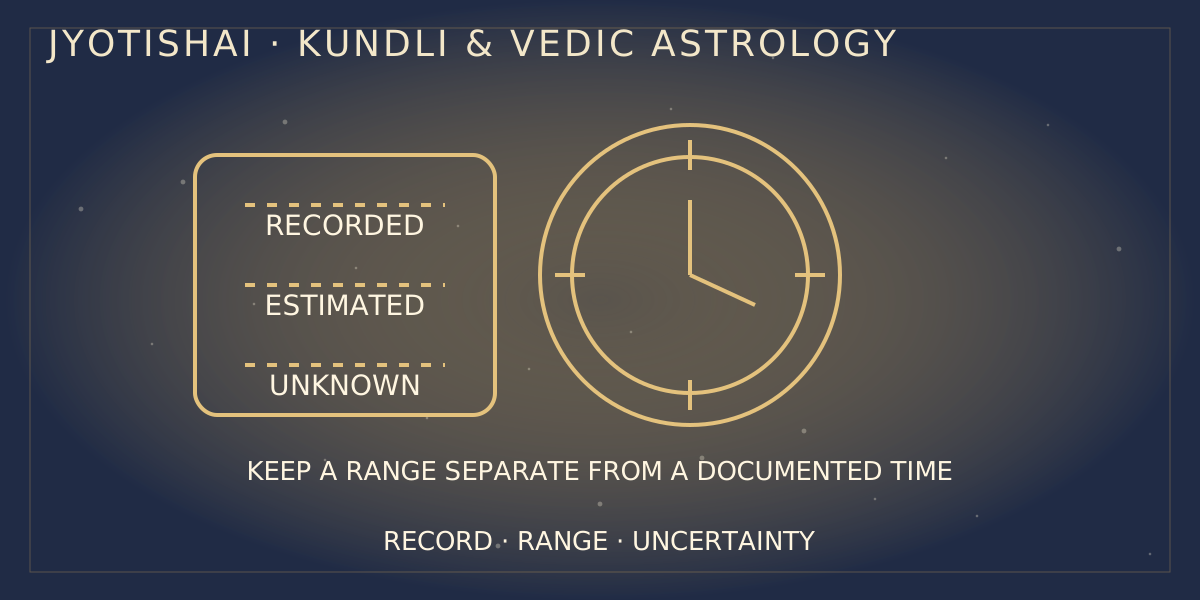
Birth-time rectification is an astrological attempt to estimate a time when the recorded time is missing, rounded or disputed. Begin with practical sources: a birth certificate, hospital record, family diary, or a relative who remembers how the time was noted. Ask whether the displayed time was exact, rounded to a quarter-hour, or simply “morning” or “evening.” A record can also contain time-zone or clock-setting errors, so preserve what it actually says. Keep the source and confidence beside the time rather than silently replacing one value with another.
What astrologers mean by rectification
In some Jyotisha practice, a reader compares charts calculated for candidate times with selected traditional factors or a person’s dated life events. Other methods use a question chart or textual procedures for a lost horoscope. These are different approaches and should not be combined without explanation. Varāhamihira’s Bṛhat Jātaka has a chapter titled “Lost Horoscopes” describing historical techniques. Its presence documents a tradition; it does not establish that an estimated minute can be independently verified or that the method is scientifically validated.
Ask for the method and the candidate range
Before sharing personal history, ask the astrologer to state the time window being considered, the chart settings, and the method used to narrow it. Ask which details are observations and which are interpretations. If the time changes after each new event is discussed, ask how the method avoids fitting a chart to the story after the fact. A responsible explanation can say that evidence is insufficient or that multiple times remain plausible. It should not promise to uncover a precise “true” time.
Use records and events carefully
If you choose to explore a rectification, use a small, pre-agreed set of dated events and note how certain each date is. Do not feel obliged to disclose sensitive details, and do not accept pressure to provide medical, relationship or financial history as proof of a chart. A family move, school change or job start may have several dates and meanings; fitting one to a chart can be subjective. Write down the original time, candidate range, event dates and the reader’s method so a later reader can see what was assumed.
Why a few minutes may change a chart display
Astrology software calculates chart positions from date, time, location, time zone and chosen settings. The ascendant and some divisional placements can change as the clock advances, so a small uncertainty may affect a particular chart feature. This is a calculation sensitivity, not proof that the selected time matches a person’s life. Ask the reader to identify which displayed placements are stable across your range and which depend on choosing one minute. Do not report uncertain placements as facts.
A practical example, without a chart claim
Suppose a family remembers a birth “around 6 in the evening,” and a document records 6:00 PM but does not explain its precision. The useful first step is to preserve both facts and ask whether another record can clarify them. If an astrologer proposes a narrower interval, label it “rectified estimate,” keep the original entry visible, and note the method and uncertainty. This example illustrates record handling only; it does not calculate a chart or demonstrate that rectification can identify a correct time.
Keep consequential choices grounded
A rectified chart is an interpretive estimate, not a substitute for a civil record or professional evidence. Do not change identity documents, delay medical care, make legal or financial decisions, or judge a relationship on the basis of a proposed time. Astrology is a cultural or spiritual framework whose interpretations vary. You can decline a session, limit personal disclosures and ask for a clear explanation of cost and privacy before proceeding.
Frequently asked questions
Can an astrologer find my exact birth time?
A reader may offer an estimate within a stated method and range. It should not be presented as a verified record unless a reliable record confirms it.
What should I check before rectification?
Look for birth or hospital records and ask family how the time was remembered or recorded. Keep each source and its precision noted.
Why do rectification results differ?
Readers may use different traditions, chart settings, candidate ranges and interpretations. Ask what method was used and what remains uncertain.
Should I use a rectified time for official matters?
No. Use authoritative civil or medical records for official purposes; an astrological estimate is not documentation.
Continue learning
Sources and context
- Varāhamihira, Bṛhat Jātaka, chapter 26: “Lost Horoscopes” (historical text and translation)
- Bṛhat Jātaka 26.1–5: Sanskrit and translation
- Drishti: Kundli without birth time (current competitor coverage)
- Astrologist.com: birth-time rectification and its limits (current competitor coverage)
- Google Search Central: people-first content guidance
Citations provide cultural or practical context; they do not endorse JyotishAI or validate astrological predictions.