The short answer
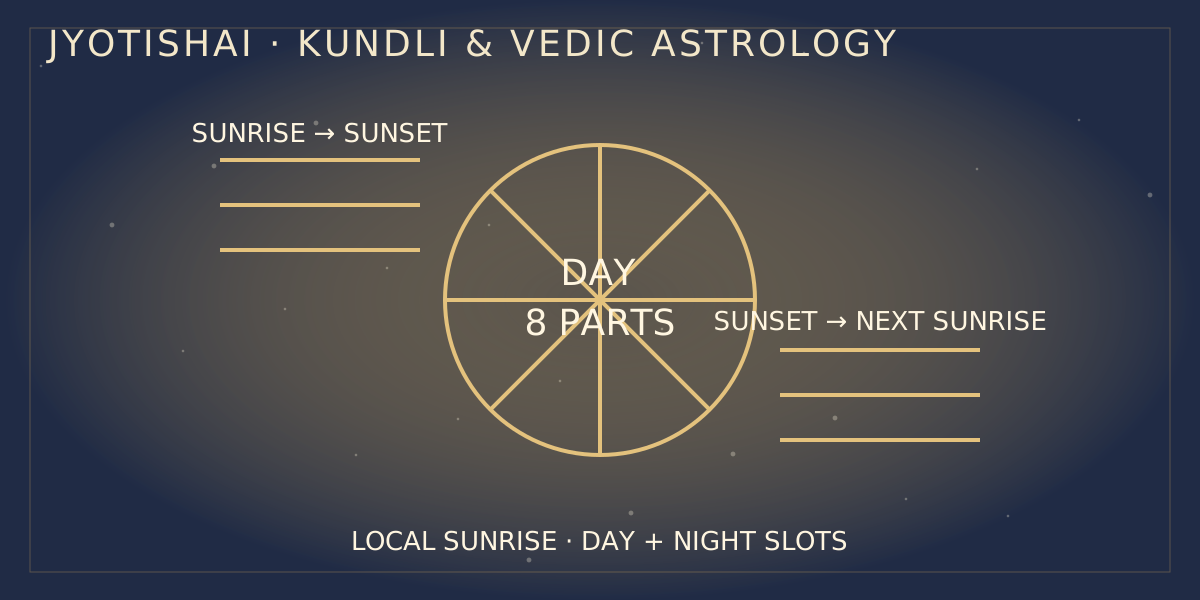
Choghadiya, also written Chaughadia or Choghadiya Muhurat, is a traditional time-selection table that divides daylight into eight intervals and nighttime into eight intervals. The intervals are calculated from that place’s sunrise, sunset and following sunrise, so their clock lengths change with the season and location. A label such as Amrit, Shubh or Labh is a traditional quality assigned by the system; it is not a promise that an activity will succeed.
What the seven names usually indicate
Many tables use seven repeating labels: Amrit, Shubh, Labh, Char (also written Chara or Chal), Rog, Kaal and Udveg. Common summaries describe Amrit, Shubh and Labh as favourable; Char as changeable or movement-oriented; and Rog, Kaal and Udveg as periods some users avoid for a new beginning. The exact descriptions and which activities suit each period can vary by almanac and regional practice. Read the explanation supplied by the Panchang you chose instead of assuming every app uses identical wording.
How the table is laid out
Look first for the city and date, then find the day table and the night table. Each section has eight rows or bands. The day sequence is anchored to local sunrise and sunset; the night sequence runs from sunset toward the next sunrise. The weekday determines the sequence shown in many published tables. Do not copy a time from a different city or season: the intervals are fractions of local daylight or night, not fixed 90-minute blocks on every date.
A practical reading example
Suppose a local table lists a “Labh” interval from 10:18 to 11:42. That label tells you how the selected tradition classifies that interval; it does not say a purchase, interview or trip will go well. First confirm that the city and date are right and whether the displayed rows are day or night. Then check whether another period your family or practitioner considers relevant overlaps it. For a routine task, you might use the table as a personal planning preference; for a major ceremony, ask for the complete method rather than treating one label as the entire selection.
Choghadiya is not the whole muhurat
A quick Choghadiya table is one layer of traditional timing practice. A broader muhurat selection may consider additional Panchang elements, the purpose of the event, location and tradition-specific rules. A favorable-looking row can overlap another interval that a particular practitioner also checks. Drik Panchang, for example, notes additional Vaar Vela, Kaal Vela and Kaal Ratri considerations in its tutorial. If the timing matters deeply to your family, ask which rules are being applied and follow the tradition you trust.
Regional practice and respectful use
Choghadiya is especially familiar in some North and West Indian contexts; related time-selection systems, including Gowri Panchangam, are used in parts of South India. Families, temples and almanacs may prefer different conventions. You do not have to use a table for ordinary decisions. Avoid delaying urgent care, travel safety, a required deadline or other evidence-based action because an interval has an unfavorable label.
A simple checklist before relying on a timing table
Confirm the selected city, date and time zone. Check whether the table divides day and night separately. Read the source’s explanation of each label and note any overlap rules. For a significant ceremony, ask whether this is a quick Choghadiya choice or a complete muhurat and which family or regional convention is being followed. Use the result as cultural guidance, not as a guarantee or substitute for practical planning.
Frequently asked questions
What does Choghadiya mean?
It is a traditional timing system that divides daylight and nighttime into eight parts each; the rows carry names such as Amrit, Shubh, Labh, Char, Rog, Kaal and Udveg.
Are Choghadiya periods always 90 minutes?
No. They are based on the length of local day or night, so interval lengths vary by date and location.
Can I use a Choghadiya time from another city?
Use the city where the activity will take place. Sunrise and sunset vary by location, so a copied time may not match the local table.
Is Choghadiya enough to select a wedding or major ceremony time?
It is a quick timing aid. A complete muhurat may consider other Panchang elements and family or regional rules, so ask what method is appropriate for your event.
Continue learning
Sources and context
- Drik Panchang: Choghadiya Muhurat tutorial and day/night tables
- KaalPanchang: Choghadiya concepts, local day/night intervals and limitations
- Google Search Central: people-first content guidance
Citations provide cultural or practical context; they do not endorse JyotishAI or validate astrological predictions.