Asta is a traditional chart condition, not a diagnosis
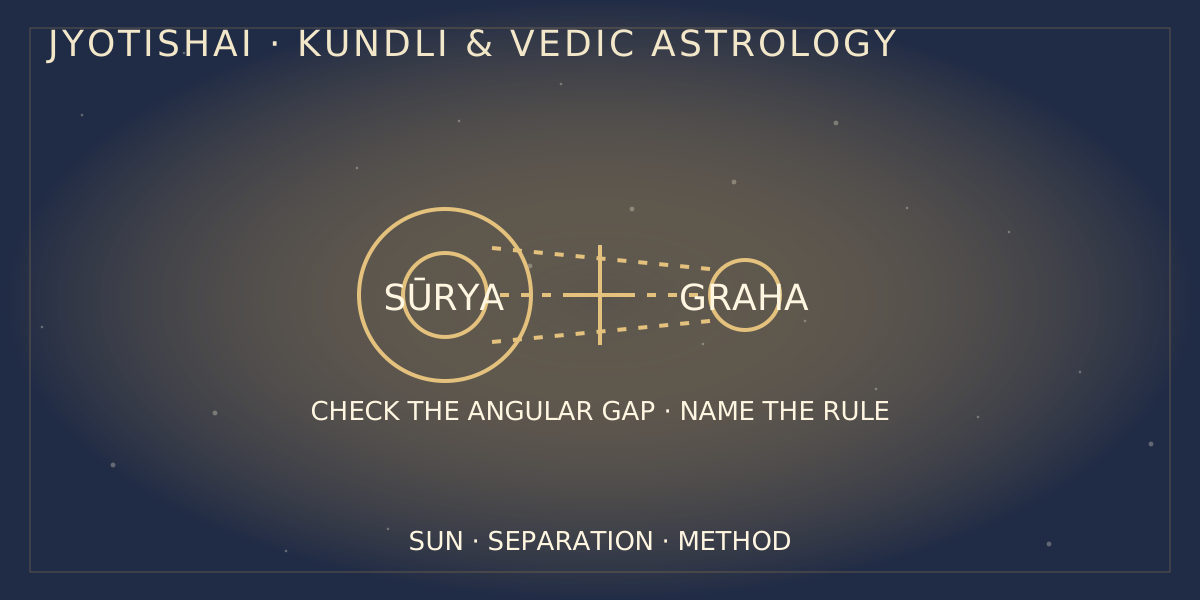
Asta (often rendered “combustion”) describes a graha’s close relation to the Sun in some Jyotisha calculations and interpretations. The word is also associated with setting or becoming unseen in astronomical descriptions. A report may use the label to discuss a planet’s strength or expression, but it does not prove that a person will fail, lose a relationship or experience a particular event. Traditions use different rules, so a careful explanation names the source or software method instead of presenting one threshold as universal.
A same-sign placement is not automatically the same label
Two planets can occupy one rāśi without being equally close by longitude. Combustion rules usually depend on angular separation from the Sun, and some methods set different limits for different grahas or motion states. This means a sign-level statement such as “both are in Leo” does not supply enough detail to reproduce a combustion result. Ask for the degrees, chart settings and threshold table used. If a report does not show them, treat its label as incomplete rather than assuming a particular effect.
Why classical tables and software may differ
Texts discuss heliacal rising and setting, planetary strength, and the Sun’s rays in ways later chart tools may implement differently. For example, the Sūrya-Siddhānta’s chapter on heliacal risings and settings gives distinct conditions for several planets and notes motion-related cases. An astronomical setting condition and a modern Jyotisha app’s longitude-based combustion flag are related ideas, but not automatically identical calculations. A transparent report explains the conversion and conventions it applies. Do not combine numbers from different sources without checking what each number measures.
Combustion, conjunction and retrograde are separate details
A conjunction describes two calculated positions that are close under a chart’s chosen convention; “combust” applies an additional rule or threshold. Retrograde is another motion-state label and does not, by itself, establish that combustion is present or absent. When comparing apps, record the birth or transit date, time zone, location, ayanāṃśa, each longitude and the app’s stated rule. Separate these inputs before discussing symbolism. A single red label cannot substitute for the full chart context or a reliable explanation.
A practical example of a better question
Suppose an app marks Mercury as combust. Instead of concluding that communication or study must go badly, ask: What is Mercury’s longitude, how many degrees separate it from the Sun, and which source defines this app’s limit? Is this a birth-chart position or a transit on a specific date? Does the reader consider sign placement, house rulership, dignity and other strength factors? This turns a frightening label into a method question. The astrologer should be able to distinguish a calculation from a personal interpretation.
Keep choices grounded in the real situation
Treat an Asta discussion as one traditional lens for reflection. Do not postpone medical care, legal duties, financial decisions or safety steps because of a chart label. Avoid anyone who promises to “remove” a condition through an urgent expensive purchase. If a cultural practice is meaningful to you, ask about its tradition, cost and risks, and choose freely. Use qualified professional advice for consequential matters and practical evidence when deciding what to do next.
A clear reading explains uncertainty
Before accepting an interpretation, ask which text or lineage it follows, how its threshold was selected, and which chart details could change the reading. Different editions, translations, calculation units and software choices may not agree. A useful reading states those limits plainly. Combustion is a calculation within a traditional framework; it is not a scientific measure of someone’s character, health, success or future.
Frequently asked questions
Is every planet in the Sun’s sign combust?
Not necessarily. Many methods use angular distance from the Sun, so sign co-presence alone does not establish the label.
Do all astrologers use the same combustion degrees?
No. Texts, lineages and software implementations can differ. Ask which rule and units a report uses.
Does a combust planet mean a bad outcome?
No. A label is one traditional interpretive factor, not a guarantee about a person or event.
Is natal combustion the same as a current transit?
No. One refers to positions calculated for birth; the other refers to positions at a later date and time. Check what the report describes.
Continue learning
Sources and context
- Sūrya-Siddhānta, chapter IX, verse 6: heliacal setting
- Sūrya-Siddhānta: Burgess translation, 1860
- Bṛhat Parāśara Horā Śāstra, chapter 7: other sources of graha strength
- NASA: visibility of planets near the bright horizon and twilight
- Google Search Central: people-first content guidance
Citations provide cultural or practical context; they do not endorse JyotishAI or validate astrological predictions.