The short answer
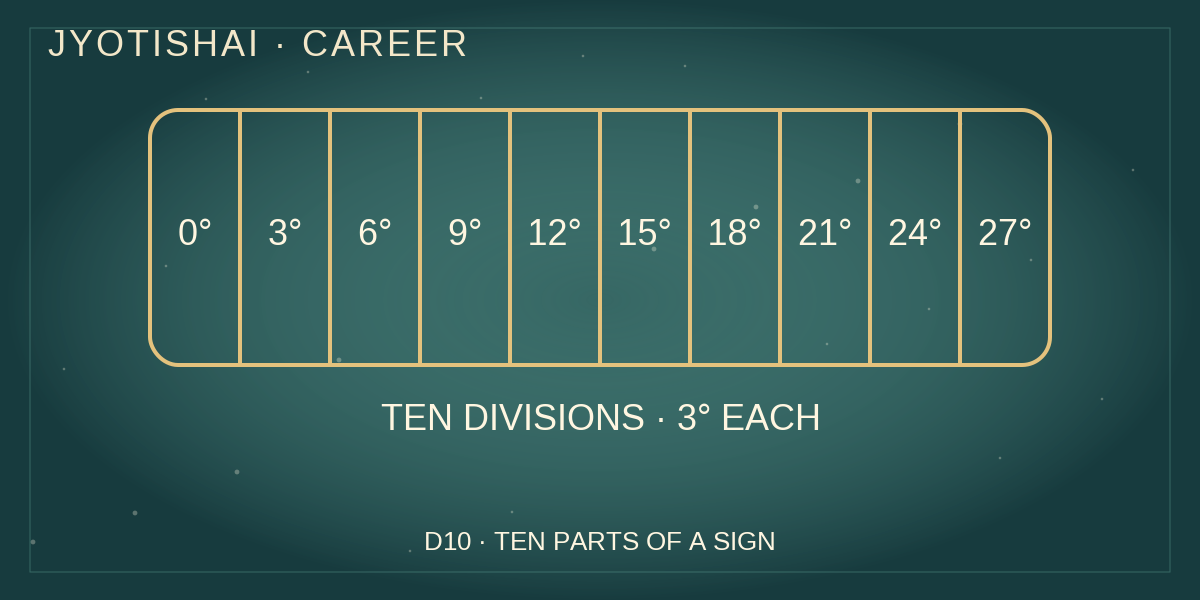
D10 is short for Dasamsa (also written Dashamsha), a divisional chart used in some Jyotisha traditions when discussing vocation, public work and responsibilities. “D10” refers to dividing each 30-degree zodiac sign into ten portions. It is interpreted as part of a wider chart reading, not as a stand-alone job selector. A chart reading is a traditional interpretive practice; it cannot establish a person’s skills, labour-market options or guaranteed career outcome.
How the D10 division is described
A translation of the Brihat Parashara Hora Shastra describes ten Dasamsa portions of three degrees each. In that translation, the counting rule begins from the same sign for an odd sign and from the ninth sign for an even sign. This is a textual description of a particular Parashari method; different teachers, texts or software can present conventions differently. The work is attributed to Parashara, while textual catalogues note that the extant compilation has a complex history. Ask which source and calculation rule a reader uses before comparing two D10 charts.
Why a recorded birth time matters
A divisional chart is derived from the exact zodiacal degrees assigned to planets and the ascendant. A small change in birth time can alter the ascendant’s degree and, near a division boundary, can change a D10 placement. If the time is approximate or remembered rather than documented, tell the practitioner. A careful reading should identify which placements are sensitive to that uncertainty and avoid presenting a precise D10 ascendant as certain when the inputs do not support it.
How to place D10 beside the main chart
In a traditional consultation, ask how the D10 relates to the Rashi or D1 chart and the career factors being discussed. A transparent explanation should name the chart method, relevant houses or rulers, and the reason for a conclusion. It should also mention what the chart cannot tell you: whether a specific employer will hire you, what a contract guarantees or how a market will change. Interpretive agreement among chart factors is still not proof of a future event.
A practical career conversation example
Suppose you are weighing a move from sales to project management. You might ask the astrologer what career themes they traditionally associate with the D1 and D10, and which placements support that reading. Separately, compare your current responsibilities, transferable skills, salary range, training needs, commute and financial buffer. Treat the chart discussion as one reflective prompt among these concrete checks. Do not quit a job, pay for an expensive remedy or reject an offer solely on a prediction.
Questions worth asking before a D10 reading
Ask whether the astrologer has your documented birth time and birthplace, which ayanamsha and divisional-chart convention the calculation uses, and whether the D10 ascendant changes if the time is a few minutes different. Ask how the main chart informs the reading and what other interpretations are possible. Before sharing personal details, review the service’s privacy information. Avoid a reader who uses fear, urgency or promised certainty to sell a remedy or influence a major decision.
Keep decisions in your hands
A D10 can be a way to explore career themes within a spiritual tradition. It cannot replace career counselling, an employment contract, financial planning or your own assessment of wellbeing and opportunity. Use qualified professional advice for legal, health and financial matters. If the chart language is not useful, you may set it aside; your work history, interests and informed choices remain central.
Frequently asked questions
What does D10 stand for?
D10 is shorthand for Dasamsa, a divisional chart in Jyotisha made by dividing each zodiac sign into ten portions under a chosen calculation rule.
Is the D10 chart only about career?
It is commonly discussed for vocation and public responsibilities in some Jyotisha approaches, but interpretations vary. It should not be treated as a complete account of work or life.
Can an inaccurate birth time change a D10 reading?
Yes. Degree-sensitive divisions and the chart ascendant can be sensitive to birth-time uncertainty. A reader should explain that uncertainty instead of hiding it.
Can D10 predict a promotion or exact job?
No chart can guarantee a specific employer decision or event. Consider practical evidence, skills, current conditions and qualified advice alongside any traditional reflection.
Continue learning
Sources and context
- Bṛhat Parāśara Horā Śāstra, translated edition, Dasamsa passage (ch. 6, verse 13–14 in this edition)
- Pramāṇa, catalogue entry for the Sanskrit text and its recensions (notes attribution and composite textual history)
- Indira Gandhi National Centre for the Arts, The Hindu Calendar (historical work on Indian calendrical systems)
Citations provide cultural or practical context; they do not endorse JyotishAI or validate astrological predictions.