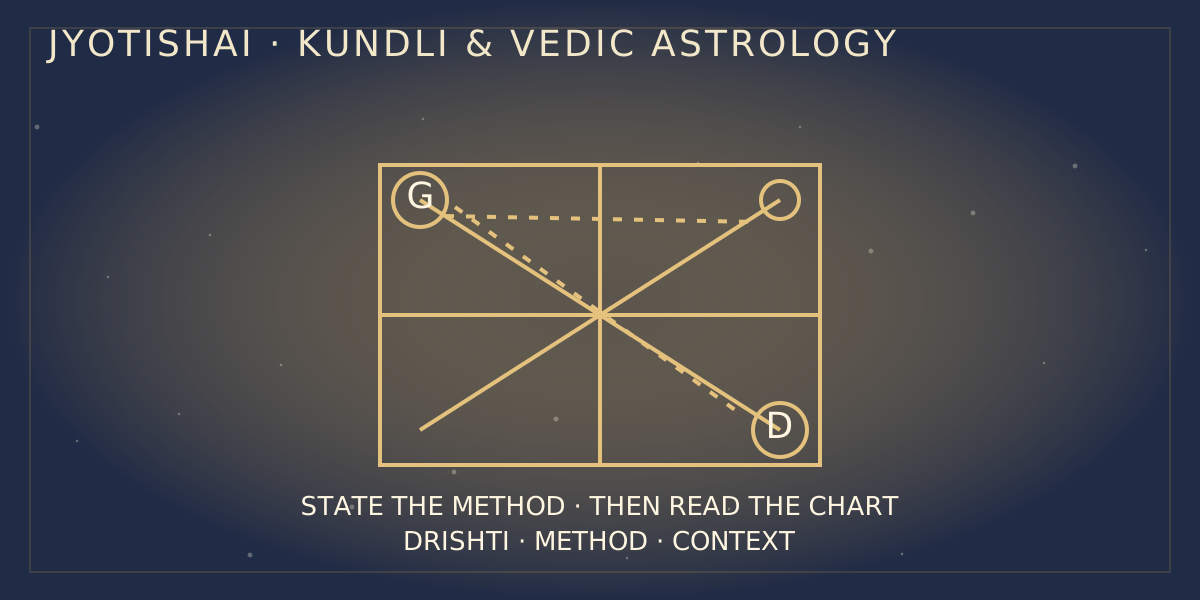
Drishti means a “glance” in a chart tradition
Graha Drishti is commonly translated as a planetary aspect or glance: a rule describing how one graha is considered in relation to another planet or point. Jyotisha texts and schools discuss more than one way to assess aspects, including sign-based relationships and position-based or graded planetary aspects. So the word “aspect” by itself is not a complete method. When a chart report says Mars or Saturn “aspects” a house, ask which convention it uses and whether it is counting signs, houses, exact degrees or another defined measure.
A common Parāśari rule set
A commonly taught Parāśari graha-aspect rule gives every graha a full seventh-from-itself aspect and adds special full aspects for Mars to the fourth and eighth, Jupiter to the fifth and ninth, and Saturn to the third and tenth. This is a particular traditional rule set, not a modern astronomical force. Other texts and schools may describe aspects differently or calculate their strengths by degrees. The Bṛhat Parāśara Horā Śāstra’s chapter on exact drishti distinguishes aspect approaches and discusses special planetary aspects; readers should consult the edition or lineage they follow.
Sign aspects and planetary aspects are not interchangeable
Some Jyotisha methods discuss Rāśi Drishti, relationships between signs, separately from Graha Drishti between planets. A chart reader may also assess exact angular separations or graded strength. These approaches can produce different answers if they are mixed silently. Before following an interpretation, ask whether the reader means a planet’s special aspect, a sign aspect, an aspect to a house, or an exact-degree relationship. A responsible report labels the method so that another reader can understand how the claim was reached.
How to follow a chart explanation
Start with the displayed D1 chart and confirm the planetary positions and sign order. Identify the aspecting graha, the target planet or house, and the stated rule. Then ask what other chart details the reader considers—such as the relevant house lord, sign, conjunctions and the question’s context. A named aspect is one piece of a reading, not enough on its own to promise marriage, conflict, wealth or a health result. If software uses an exact-degree score, ask for the angular data and scale.
A practical example without a fate claim
Imagine a report says that Saturn aspects the tenth house. Ask whether it applies the common Parāśari special-aspect count, a sign-aspect method or a degree-based score, and which chart the report uses. Then ask how it combines this with the tenth-house sign, its ruler and other factors. A useful explanation may offer a traditional reflection prompt about responsibility or long-term work. It should not claim that a promotion, job loss or delay is certain because of one aspect.
Why aspect calculators may disagree
Two apps may show different aspect lists because one counts house positions, another uses signs, and another calculates degree-based strength. They may also disagree about which grahas are included in a particular rule, chart settings, house systems or rounding. Compare the named method and input positions before comparing results. If an app says “strong aspect,” look for a definition of strength. Do not treat an unexplained score as a probability or an objective measure of how a life event will unfold.
Use aspects as context, not certainty
A clear reading explains which tradition it uses, how a rule was applied and what remains uncertain. Traditions are diverse, and interpretations are not scientifically established predictions. Use them for cultural learning or reflection while making real decisions with relevant evidence and qualified professional advice. Never delay healthcare, legal obligations, financial protections or safety actions because of a chart aspect.
Frequently asked questions
What is Graha Drishti?
It is a traditional Jyotisha framework for describing how one graha aspects another planet, house or point. The exact rules depend on the named method.
Which planets have special aspects in a common Parāśari rule?
In a commonly taught rule, Mars has special fourth and eighth aspects, Jupiter fifth and ninth, and Saturn third and tenth, in addition to the seventh aspect.
Are Rāśi Drishti and Graha Drishti the same?
No. They are distinct aspect approaches in some Jyotisha traditions. Ask which one a report applies.
Does one aspect guarantee an event?
No. An aspect is one traditional interpretive factor and cannot guarantee a specific personal outcome.
Continue learning
Sources and context
- Bṛhat Parāśara Horā Śāstra, chapter 26: exact graha aspects
- Bṛhat Parāśara Horā Śāstra, chapter 26: translation and chapter overview
- Google Search Central: people-first content guidance
Citations provide cultural or practical context; they do not endorse JyotishAI or validate astrological predictions.