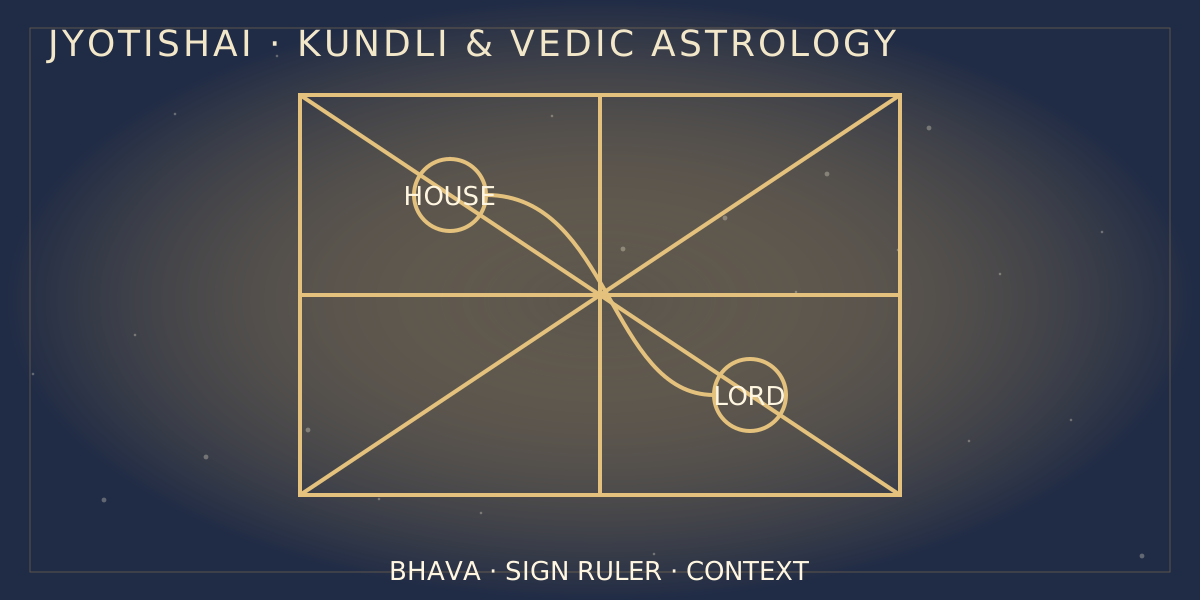
House, sign and house lord are different things
In a Vedic birth chart, a bhava or house is one of twelve chart areas. Each house contains a zodiac sign in the chart layout. The planet traditionally assigned rulership of that sign is called the house lord or house ruler. The house is the area being discussed; the sign gives a style or framework in the tradition; the lord is one planet astrologers examine in relation to that house. These are connected concepts, not interchangeable labels.
How to identify a house lord
First identify the ascendant and the chart’s house-sign layout. Find the sign shown in the house you are studying. Then consult the rulership scheme used by the astrologer to identify that sign’s planetary ruler. In the common classical scheme, for example, Leo is ruled by the Sun and Taurus by Venus. Traditions and chart settings should be stated clearly, especially when a software display uses abbreviations or a different house format.
A hypothetical chart example
Imagine a chart with Leo on the first house. Under the common classical sign-ruler scheme, the Sun is the ruler associated with that house, so a reader may call the Sun the first-house lord. The next question is where the Sun is placed and how it relates to the rest of the chart. This example shows the naming process only; it does not infer a real person’s life, temperament or outcome.
Why the lord’s placement is considered
Traditional readers may consider the lord’s house and sign placement, conjunctions, aspects, dignity and timing techniques. Which factors matter most varies by school and question. A statement about a house lord should therefore explain its basis. “The seventh lord is in a certain house, so marriage will happen on a fixed date” skips context and claims more certainty than a chart can establish.
A beginner’s chart-reading checklist
Write down the house number, sign in that house, sign ruler and the ruler’s chart placement. Confirm the ascendant and whether the chart uses whole-sign houses or another house calculation. Then ask what other placements support or complicate the interpretation. If the birth time is uncertain, note that house cusps or the ascendant may be less reliable in the chosen method.
Avoid single-factor predictions
A house lord is a useful piece of traditional chart vocabulary, not a standalone verdict. People’s decisions, relationships, opportunities and circumstances cannot be reduced to one planet. Use an explanation as a reflection prompt, check practical facts independently and seek qualified professional support for health, financial, legal or safety decisions.
Questions to ask an astrologer
Which sign is in this house, and which rulership scheme are you using? Where is the house lord placed? What other chart factors support or change this interpretation? How does uncertainty in my birth time affect it? What practical choice remains mine regardless of the reading? Clear answers make the method easier to understand and keep the conversation grounded.
Frequently asked questions
Is a house lord the same as a planet inside the house?
No. A planet placed in the house and the planet ruling its sign can be different planets. Both may be considered in a traditional interpretation.
How do I find the seventh-house lord?
Identify the sign in the seventh house, then apply the sign-rulership scheme used by your chart method to find its ruler. Confirm the ascendant and house layout first.
Does a house lord guarantee an event?
No. It is one element in an interpretive tradition, not a guarantee of a specific event or date.
Can house lords differ between astrology systems?
Yes. Methods and rulership conventions can vary. Ask which system and chart settings are being used.