A clock value needs a label
A Panchang entry can show when a tithi, nakshatra, yoga or karana ends, when it starts, or which one is in effect at a reference moment. The number alone is not enough. For example, “Chaturdashi — 14:15” may mean that the tithi prevailing at sunrise ends at 2:15 PM in that calendar’s display convention. Drik Panchang documents this end-time style for its daily entries. Other publishers may label or arrange the data differently, so read the page legend before interpreting a time.
Check the selected location first
Panchang timings are tied to a place and time zone. A calendar set to Delhi can show different sunrise and local event times from one set to Chennai, even on the same civil date. Check the city, state or coordinates, time zone and daylight-saving handling if relevant. If you travel, change the location before comparing listings. A saved city in an app may persist from an earlier session, so do not assume the displayed date automatically uses your current location.
Why sunrise appears in daily Panchang labels
Some daily Panchang formats identify the tithi or other limb that is prevailing at local sunrise, then show when it ends. That does not mean the tithi lasts for the whole civil day. A tithi may end before sunset or begin after sunrise. Drik Panchang explains its own timing labels and states that its displayed times are local; this is a provider’s documentation of its format, not a universal specification for every calendar.
The daily label is not automatically the festival rule
A date shown with a tithi label does not, by itself, settle every observance. Festival and ritual decisions may use a particular interval or rule, and practices can differ by region, sampradāya, family or local authority. Check the specific observance guidance and its cited convention rather than applying “tithi at sunrise” to every event. When a date matters, compare a local Panchang and ask a knowledgeable community or temple source which rule they follow.
A simple way to decode a listing
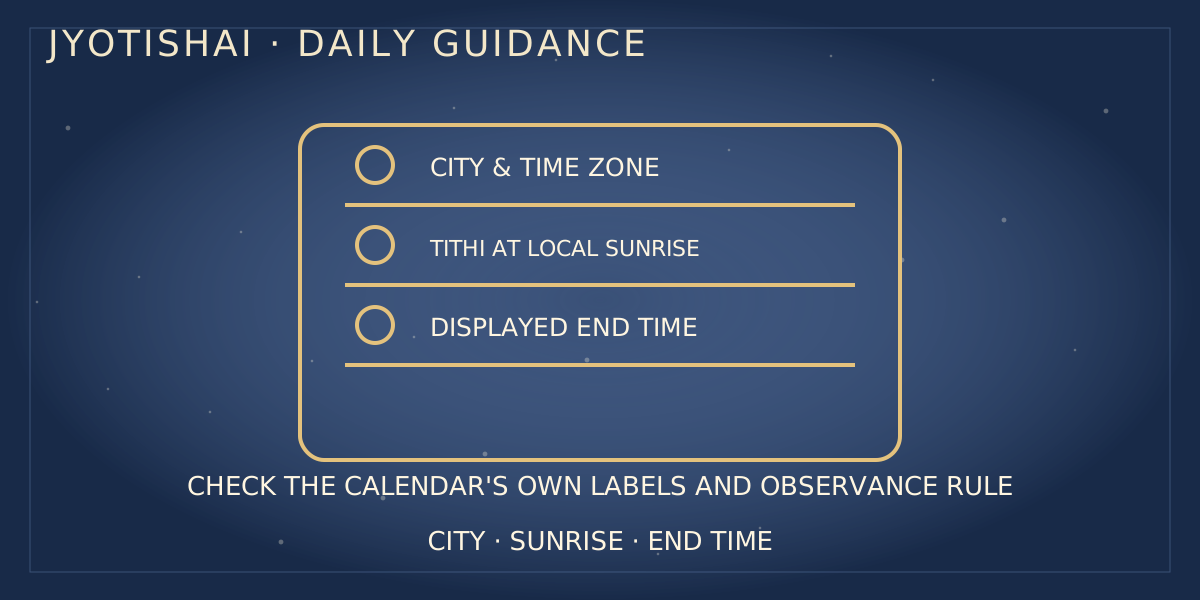
Read a Panchang line in this order: selected city; civil date and time zone; the named limb; whether the value is a start or end; the reference moment, such as sunrise; and any observance-specific rule. If a tithi is listed as ending at 10:40 AM, check whether the calendar means the tithi active at sunrise ends then. Do not silently read that value as the tithi beginning at 10:40. A publisher FAQ or legend should resolve the convention.
Why two Panchang apps may show different values
Differences can come from location, sunrise convention, time zone, ephemeris, calculation settings, rounding, or whether a display shows a start, end or sunrise value. Festival dates may also follow a rule distinct from a general daily listing. Record the exact settings and compare like with like before concluding that one app is wrong. If a provider does not expose its location or convention, ask for it or use a source that does.
Use Panchang information with cultural context
A Panchang can support cultural learning and planning, but traditions are not uniform and calculations depend on inputs. If an observance matters to you, consult the specific tradition you follow. Do not postpone healthcare, safety actions, legal duties or financial protections because of an auspicious-time listing. Use practical information and your own judgment for consequential decisions.
Frequently asked questions
Does a Panchang time usually show when a tithi begins?
Not always. Some publishers display the end time of the tithi active at sunrise. Check that calendar’s legend or FAQ.
Why do Panchang times change by city?
The displayed local times depend on geographic location, time zone and the calculation convention used by the provider.
Does the tithi at sunrise decide every festival date?
No single daily label answers every observance. Festival rules may use a specific interval and can vary by tradition or region.
What should I compare when two apps disagree?
Confirm city, date, time zone, sunrise reference, start/end labeling, calculation settings and the observance rule before comparing values.
Continue learning
Sources and context
- Drik Panchang FAQ: reading Panchang timings and end-time labels
- Drik Panchang FAQ: Hindu sunrise and sunset definitions
- Sarva Panchang FAQ: location and sunrise in Panchang displays
- Google Search Central: people-first content guidance
Citations provide cultural or practical context; they do not endorse JyotishAI or validate astrological predictions.