What does “pada” mean?
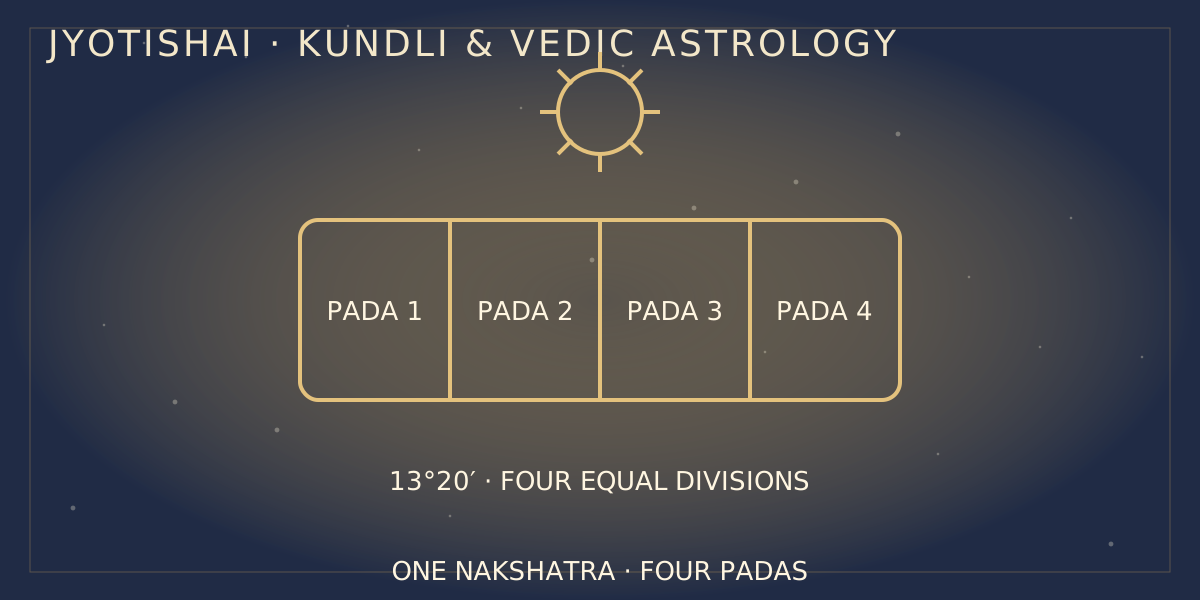
Pada means a quarter or part. In one common Jyotisha framework, the 360-degree zodiac is divided into 27 Nakshatras, each spanning 13 degrees 20 minutes. Each Nakshatra is then divided into four equal padas of 3 degrees 20 minutes. The word can also carry other meanings in Sanskrit and in ritual or poetic contexts; here it refers specifically to a Nakshatra quarter.
How the four quarters fit into one Nakshatra
Imagine a Nakshatra as a 13-degree-20-minute arc along the zodiac. Its first pada covers the opening 3 degrees 20 minutes, the second the next 3 degrees 20 minutes, and so on through the fourth. The padas are ordered subdivisions, not four separate Nakshatras. Because a Nakshatra can cross a zodiac-sign boundary, a pada can also be associated with a Navamsha division in traditional chart methods. The precise mapping depends on the chart conventions being used.
A simple, non-personal example
Suppose a chart calculator places the Moon at 8 degrees inside a particular Nakshatra. Since 8 degrees lies in that sector’s third 3-degree-20-minute segment, the calculator would label it pada 3. This is only an illustration of the arithmetic; it is not a reading of anyone’s chart. A real result depends on the Moon’s calculated longitude, birth details, time-zone handling and the chosen settings.
What astrologers may use a pada for
Some Jyotisha traditions consider a pada when discussing naming syllables, compatibility methods, divisional-chart symbolism or finer-grained interpretations. Practices differ by region, lineage and software settings. A pada is one traditional chart detail, not a complete personality profile and not evidence that a specific event will happen. Ask the reader to explain which method they are applying and why it matters to your question.
Why birth-time uncertainty can matter
A pada is determined from a precise position within the zodiac sector. When the Moon is close to a boundary, a small difference in recorded time or calculation settings can change the displayed pada. If your birth time is rounded or uncertain, tell the calculator or astrologer instead of treating one exact quarter as settled. The Nakshatra itself may also be near a boundary.
How to read a result carefully
Check the birth date, local time, birthplace and time-zone setting first. Then note the Moon sign, Nakshatra and pada shown, along with the calculation method if it is provided. Ask what the pada contributes beyond the broader Nakshatra and Moon-sign themes. A careful explanation should distinguish the tradition’s symbolic language from verifiable facts and should leave space for your own experience and judgment.
Use the detail as a question, not a verdict
A useful follow-up is: “Which traditional rule are you using for this pada, what other chart factors could change the interpretation, and what practical reflection can I take from it?” This keeps a technical chart label in proportion. Do not make medical, legal or financial choices, or spend money on an urgent remedy, solely because of a pada reading.
Frequently asked questions
How many padas are in each Nakshatra?
The common 27-Nakshatra system divides each Nakshatra into four equal padas, each 3 degrees 20 minutes of zodiac longitude.
Is a pada the same as a Nakshatra?
No. A Nakshatra is the larger sector; a pada is one of its four subdivisions.
Can the pada change if my birth time is uncertain?
If the Moon is close to a pada boundary, a time or calculation difference could affect the result. Record the uncertainty and check the settings before relying on it.
Does one pada determine personality or destiny?
No. It is one factor within a traditional interpretive system and does not determine a person’s character or future.