The short answer
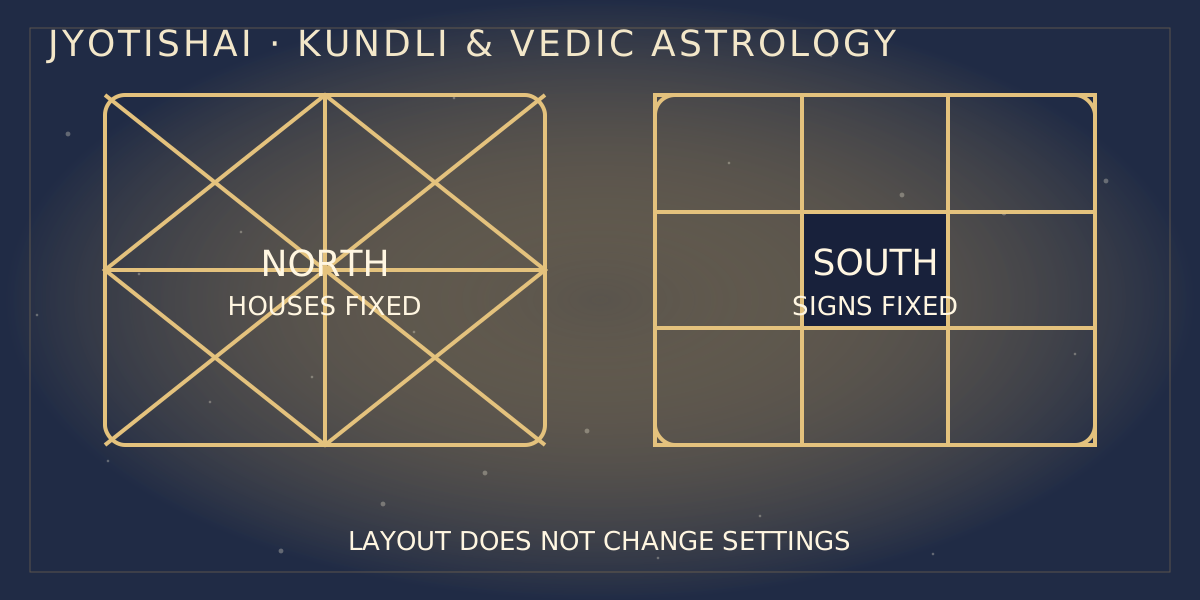
North Indian and South Indian Kundli charts are two common ways to draw a Vedic birth chart. In the usual North Indian layout, the houses stay in set positions and the sign numbers change with the Lagna. In the usual South Indian layout, the signs stay in set boxes and the houses are counted from the marked Lagna. If the birth details and calculation settings match, changing the drawing style does not by itself change the chart placements. Regional formats and software conventions can vary, so read the chart legend before interpreting it.
How to orient a North Indian chart
The familiar North Indian diagram places the first house at the upper centre, with the other house positions arranged around the diamond. These house positions remain fixed from chart to chart. A small number or sign label in a house identifies the Rashi occupying it; it is not the house number. Find the Lagna marker and its sign first, then note which sign number appears in each fixed house. For example, if the first-house cell is marked with sign 4, the chart is showing Cancer as the rising sign in that format. Confirm the legend because some charts use names or different labels instead of numbers.
How to orient a South Indian chart
The South Indian square-grid layout usually keeps the twelve zodiac signs in the same perimeter positions. The centre is often left open for a name, date or chart heading. Find the box marked Lagna, Asc or a similar indicator; that is the first house for this chart. From there, follow the counting direction shown by the chart’s legend to identify the remaining houses. A planet’s sign comes from the box it occupies, while its house depends on where the Lagna begins. Do not assume that a fixed box always means the same house.
A simple comparison without recalculating
Imagine a chart whose Lagna is Cancer and whose Moon is shown in Libra. In a North Indian layout, you would look for the first-house cell and read Cancer as its sign, then locate Libra in whichever fixed house cell contains that sign number. In a South Indian layout, you would find the fixed Cancer box marked as Lagna, then locate the fixed Libra box and count houses from Cancer. This example describes only the layout; it does not make a prediction or establish any other planet placements. If two chart images seem to disagree, compare their date, time, place, zodiac setting and house method before assuming the drawing is the cause.
Signs, houses and chart settings are different things
A sign (Rashi) and a house (Bhava) answer different questions within a reading tradition: the sign marks a zodiac division, while the house is a chart sector counted from the ascendant or another stated reference. A chart can also be generated with different ayanamsha, house or node settings. These choices may affect the labels or placements shown. A layout switch is only a presentation change when the underlying calculation settings are the same. When comparing two calculators, write down the settings each one uses instead of trying to infer them from colour, shape or location on the page.
Which format should a beginner use?
Choose the layout you can follow consistently. If you think in terms of a question such as “which house is being discussed?”, a house-fixed North Indian chart may feel easy to scan. If you prefer to track a sign in the same place across charts, the South Indian layout may feel more familiar. Neither display style is a proof that one reading is more accurate. Keep the chart’s legend visible, identify the Lagna, separate sign from house, and ask the reader to explain the calculation settings before relying on an interpretation.
A practical checklist before asking for a reading
Check that both charts use the same birth date, local time, place and time zone. Confirm the selected zodiac and ayanamsha if the calculator provides them. Find the Lagna mark and read the chart’s legend. In a North Indian chart, distinguish the fixed house position from the sign number written in it; in a South Indian chart, distinguish the fixed sign box from the house counted from the Lagna. If an important placement differs, ask which calculation setting changed. Treat the chart as a traditional framework for reflection, not a verdict about identity or future events.
Frequently asked questions
Are North Indian and South Indian Kundli charts different calculations?
Usually they are different display layouts. Compare birth details and calculation settings to confirm that the placements themselves match.
Which Kundli format is more accurate?
Neither layout is inherently more accurate. Accuracy depends on the birth data, calculation method and settings, not the diamond or square-grid drawing.
In a North Indian chart, are the numbers house numbers?
Commonly they are zodiac-sign numbers, while the house positions stay fixed. Check the chart legend because labels can vary.
How do I find the first house in a South Indian chart?
Locate the box marked Lagna, Asc or an equivalent marker. That sign box begins the first house; use the chart’s legend to count the rest.
Continue learning
Sources and context
- Jyotira: How to Read Your Janam Kundli — chart format overview
- AstroVeeda: How to Read a Kundli — North and South chart descriptions
- Google Search Central: Creating helpful, reliable, people-first content
Citations provide cultural or practical context; they do not endorse JyotishAI or validate astrological predictions.