What does Panchang mean?
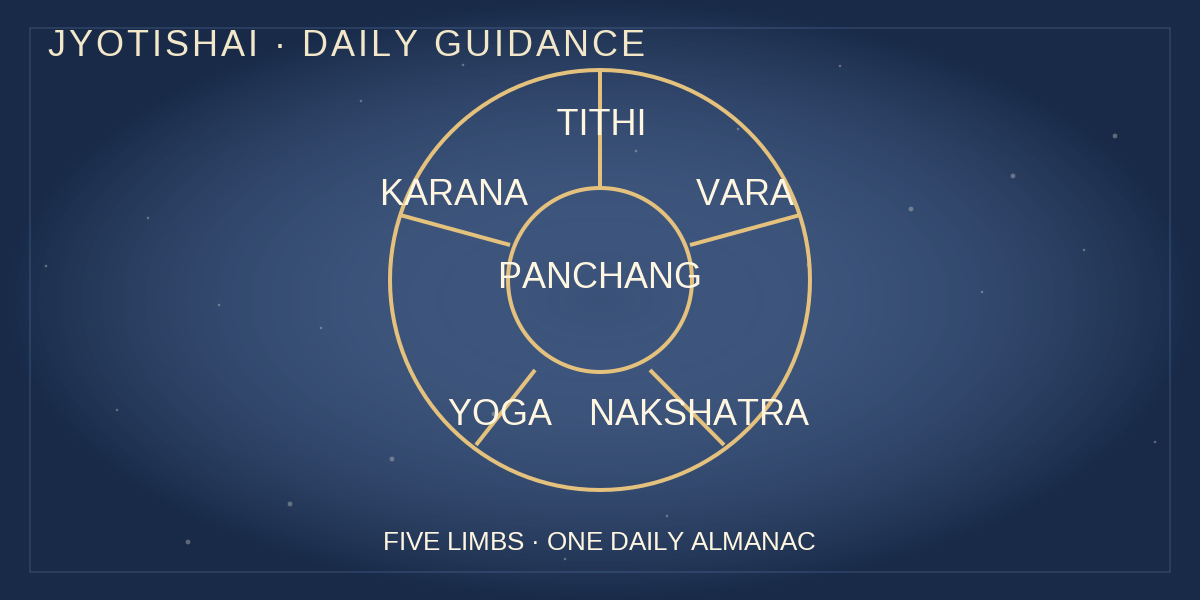
Panchang (Pañcāṅga) is commonly explained as “five limbs.” A daily almanac brings together five traditional measures of time: vāra (weekday), tithi (lunar day), nakṣatra (lunar mansion), yoga and karaṇa. The Government of India’s Positional Astronomy Centre describes the Rashtriya Panchang as a national publication with calendar and astronomical data, while historical explanations also list these five components. A Panchang is both a calendar reference and, in Jyotisha practice, a source used when discussing traditional timing. Its cultural role does not make every interpretation a guaranteed forecast.
The five parts in plain language
Tithi describes a lunar day in the traditional lunisolar calendar. Vara is the weekday; in many Indian calendrical calculations it is counted from sunrise. Nakshatra identifies the lunar mansion associated with the Moon’s position. Yoga is a separate calendrical factor calculated from Sun and Moon positions in the relevant system. Karana is half of a tithi. These are technical calendar labels, not personality types. A published Panchang may also show sunrise, moonrise, festival notes and time intervals, so read the legend rather than assuming every column is one of the five limbs.
Why the end times do not match midnight
Unlike a civil date, several Panchang factors change at their own astronomical or calendrical transition times. A tithi or nakshatra may begin or end partway through a local day. That is why an almanac can list an ending time beside a factor and then show the next one. Location, time zone, calculation convention and the almanac’s day-boundary rule can affect how a daily entry is presented. The Positional Astronomy Centre publishes data for specified locations and calendar conventions; check which location and time standard your app or printed Panchang uses before comparing two entries.
How to read a daily Panchang without getting lost
Start with the date and city printed at the top. Then find sunrise and the five factors; note any transition times instead of reading a label as if it applies for the full civil day. If you are checking a festival observance or selecting a muhurta, look for the stated regional tradition and relevant observance rule. Do not combine a time from one city with a day label from another. When two calendars differ, compare their source, location, time zone and method before deciding that one is a mistake.
A practical example
Suppose a calendar lists one tithi until 10:40 a.m. and the next afterward. The useful reading is that the tithi changes during the local day; it does not mean that midnight moved or that every ritual follows the same rule. An observance can depend on a specific tradition’s rule about sunrise, a particular interval or the festival in question. For an important religious observance, follow the local temple, family or community practice you trust and ask how the published time was calculated.
Use the Panchang as a reference, not a verdict
People consult Panchangs for festivals, vrata observances and traditional muhurta discussions. The five limbs alone do not decide whether a plan is safe, affordable or right for your family. If you seek an auspicious time, ask the practitioner which factors matter for the activity, which regional convention is used and what practical constraints should take priority. Never delay urgent medical care, ignore safety guidance or make a financial or legal decision solely because a calendar labels a time favourable or unfavourable.
Frequently asked questions
What are the five limbs of Panchang?
They are vāra, tithi, nakshatra, yoga and karaṇa. Their exact calculation and presentation may depend on the calendar convention and location.
Is Panchang the same as a horoscope?
No. A Panchang is a traditional calendar/almanac with time and date factors. A horoscope is an astrological interpretation, often based on a birth chart or a general sign.
Why do two Panchang apps show different end times?
They may use different locations, time zones, calculation settings, rounding or day-boundary conventions. Compare the settings and source before comparing values.
Does one Panchang factor decide whether a time is auspicious?
A single factor is not a complete traditional muhurta analysis, and traditions differ. Ask which rule is being applied and keep practical considerations central.
Continue learning
Sources and context
- India Meteorological Department: Rashtriya Panchang and Positional Astronomy Centre
- Government of India, Namami Gange: Brahmasiddhānta, Indian Calendar section
- India Meteorological Department: Rashtriya Panchanga 2026–27
Citations provide cultural or practical context; they do not endorse JyotishAI or validate astrological predictions.