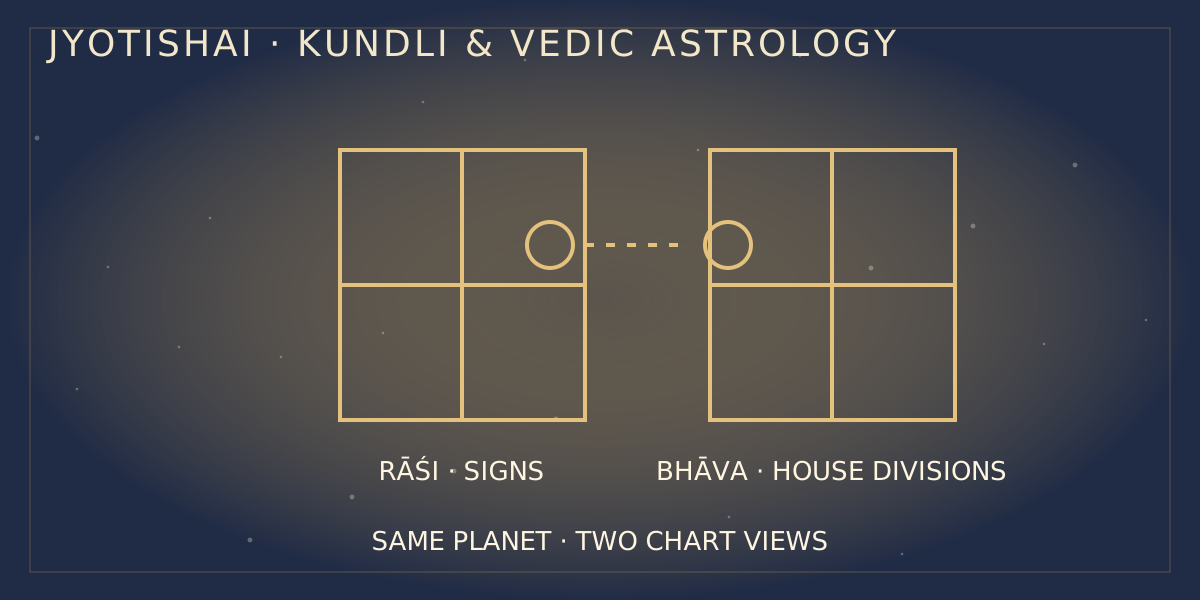
Two views of one calculated sky
A Rāśi chart and a Bhāva Chalit chart are two ways some Jyotisha software presents a birth chart. The Rāśi view emphasizes the zodiac sign occupied by a planet and often maps signs to houses in a whole-sign layout. A Chalit view uses house divisions calculated by the software’s selected method. The planet’s astronomical longitude has not changed between the two panels; the display’s house assignment may. Traditions and programs do not all use the same settings, so a Chalit label should be read with its method stated.
What the Rāśi chart helps you see
The Rāśi, or D1, chart is commonly used to inspect which sidereal sign each graha occupies and how signs, rulers and other chart factors relate within a chosen Jyotisha method. A planet’s sign remains the same when you switch chart-display views, assuming the birth data and calculation settings are unchanged. The chart style—North Indian, South Indian or another layout—changes how the boxes are drawn on screen, not the underlying sign longitudes.
What a Chalit view adds
Bhāva means a house or domain in this context. A Chalit presentation displays house divisions based on a selected calculation convention; depending on the method, their boundaries may not match sign boundaries. If a planet is close to a boundary, one program may display it in a different house view than the Rāśi chart does. This is a difference in representation and interpretive convention, not evidence that the planet physically shifted or that one chart is automatically a mistake.
A simple example of a chart disagreement
Imagine a report places a planet near a boundary between two houses. Its sign label stays identical in both chart views, while the Rāśi grid associates it with one whole-sign house and the Chalit panel assigns it according to its calculated house divisions. A thoughtful reading first confirms the birth time, city, time zone, ayanāṃśa and house method. Only then should the reader explain how their chosen school uses the two views. Avoid turning a one-house difference into a definite claim about marriage, health, money or career.
Why two apps may not match
Differences can come from rounded birth times, a wrong location or time-zone conversion, different ayanāṃśa settings, distinct house-division methods, or different rules for displaying a planet near a boundary. Compare the input details and settings before comparing interpretations. If a birth time is approximate, say so; a chart calculation cannot silently remove that uncertainty. Jyotisha schools also differ in which chart view they emphasize for a particular question.
Questions that make a reading clearer
Ask the reader to identify the chart view, name the house-division method and ayanāṃśa, confirm the local birth time and explain why the house label differs. Ask what remains unchanged between the views and what interpretive rule they apply. If the answer is a threat, a guarantee or pressure to buy a remedy, step away. Use chart discussion as cultural reflection; base medical, legal, financial and safety decisions on appropriate evidence and qualified professional advice.
Read the difference without fear
A chart comparison is most useful when it explains a method rather than declares a fate. Rāśi and Chalit labels may serve different interpretive purposes in some lineages, and readers may not agree on how much weight to give each. The practical takeaway is straightforward: verify inputs, ask what the software is displaying, and treat the explanation as one traditional perspective rather than a guaranteed outcome.
Frequently asked questions
Does a planet physically move between Rāśi and Chalit charts?
No. The chart views can assign different house labels, but the calculated planetary position is unchanged when the inputs and settings stay the same.
Why does my planet appear in a different house?
The views may use different house-assignment conventions. Birth time, location, time zone, ayanāṃśa and house method can also affect a chart.
Which chart is the correct one?
There is no single answer across every Jyotisha school. Ask which view and method a reader is using and why it fits the question.
Can a Chalit chart predict an event with certainty?
No chart view can guarantee a specific personal outcome. Use practical evidence and professional advice for consequential decisions.
Continue learning
Sources and context
- ePandit: Bhava Chalit chart and Śrīpati method context
- Jagannath Hora: Rāśi chart and Bhava Chalit comparison
- Google Search Central: people-first content guidance
Citations provide cultural or practical context; they do not endorse JyotishAI or validate astrological predictions.