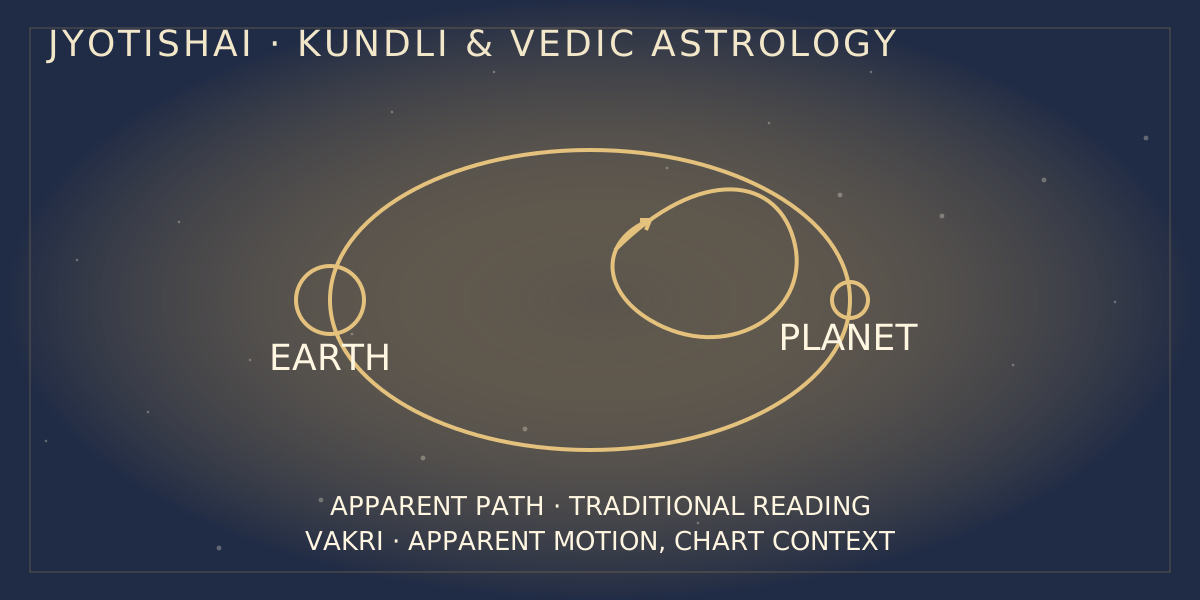
What “retrograde” describes in astronomy
A planet in the solar system does not reverse its orbit when it appears retrograde from Earth. Against the distant background stars, its apparent position can seem to slow, pause and move backward for a time because Earth and the planet are moving along different orbits. NASA describes this as an apparent change in the planet’s motion through the sky. This astronomical description is separate from the symbolic meaning a Jyotisha school assigns to a chart position.
Vakri Graha in a Jyotisha chart
Vakri is a traditional term used for a graha whose calculated motion is retrograde under a given chart convention. In a birth chart, the label is a positional detail, not a complete prediction. Bṛhat Parāśara Horā Śāstra’s discussion of planetary strength includes different motion states within its Cheshta Bala framework. Practitioners may interpret that material differently, so it is inaccurate to say that every retrograde planet is automatically weak, harmful or exceptionally powerful.
What else belongs in the interpretation
A reader may consider which planet is retrograde, the sign and house shown in the chart, its house ownership, aspects, conjunctions, dignity and the broader question being asked. Some readings also bring in divisional charts or timing periods. These are traditional methods, and schools vary. One “R” symbol on a chart cannot establish a person’s character, predict a specific event or settle a decision.
Use a simple example without turning it into a verdict
If a report marks Mercury as Vakri, ask which chart settings produced that mark and how the astrologer interprets Mercury’s role in this particular chart. You might follow with: “What other placements support that view?” and “What practical choice does this help me reflect on?” A careful answer should avoid generic promises about communication, career or relationships based on retrogression alone.
Birth chart and transit reports are different
A natal chart describes the calculated positions for a birth moment; a transit report describes positions for another date and time. The same planet can be direct in one chart and retrograde in a later sky position. Check the date, time zone, location and whether the report is natal or current before discussing its meaning. Do not copy a social post about a current retrograde into a personal birth-chart interpretation.
Questions that make a reading clearer
Ask the reader to distinguish astronomical apparent motion from astrological symbolism, show the chart inputs, name the interpretive tradition, and explain which other factors matter. If an explanation predicts disaster or demands an urgent purchase, step back and seek another perspective. Do not delay healthcare, legal duties, financial obligations or safety action because a planet is retrograde.
A symbol is not a guarantee
Astrology offers a traditional symbolic framework; it is not a scientific method for establishing personal outcomes. Sources below support the astronomy explanation and document a classical Jyotisha strength framework, not the validity of individual predictions. Use the material for cultural learning and reflection while keeping practical decisions grounded in evidence and your own judgment.
Frequently asked questions
Does a retrograde planet actually move backward in space?
No. In ordinary planetary retrograde as seen from Earth, the backward path is apparent against the background sky; the planet continues along its orbit.
Does Vakri mean a planet is bad or weak?
Not by itself. Jyotisha interpretations vary, and a chart reader may consider other placements and strength factors.
Are Mercury retrograde and a natal retrograde the same thing?
No. One refers to a planet’s apparent motion during a period in the sky; the other is a position recorded for the birth moment in a natal chart.
Should I avoid important decisions during retrograde?
A retrograde label is not evidence that an ordinary decision will fail. Use practical information and qualified professional advice for consequential matters.
Continue learning
Sources and context
- NASA: apparent retrograde motion as Earth overtakes a planet
- Bṛhat Parāśara Horā Śāstra, Chapter 27: planetary strength and motion states
- Google Search Central: people-first content guidance
Citations provide cultural or practical context; they do not endorse JyotishAI or validate astrological predictions.