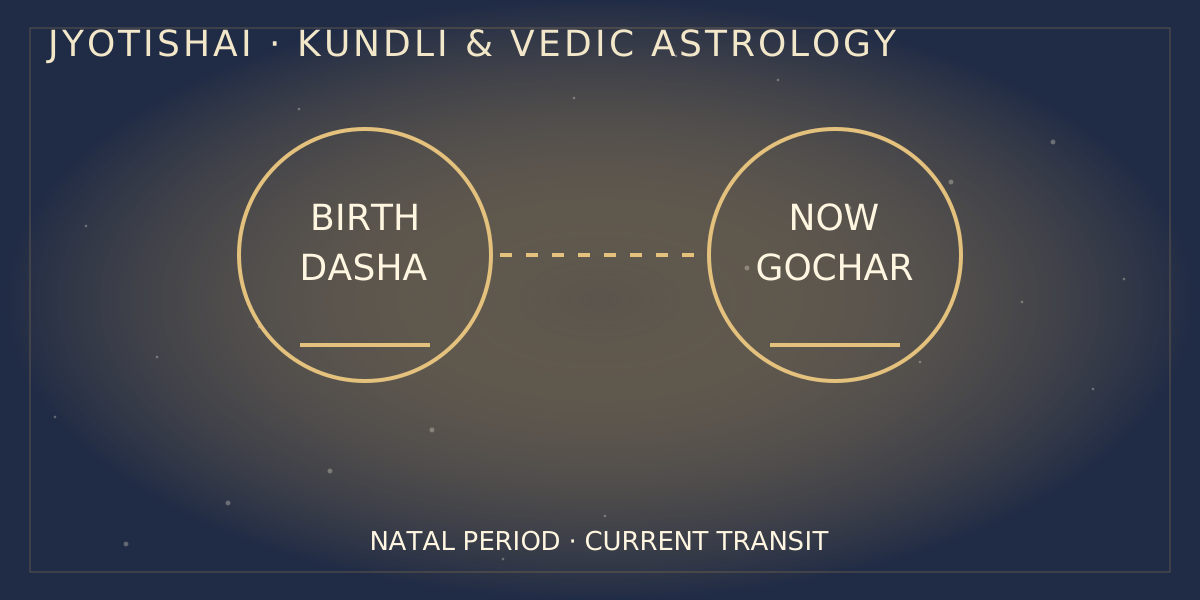
The short answer: a period and a moving sky
Vimshottari Dasha and Gochar answer different kinds of timing questions in Jyotisha. A Dasha is a named period in a sequence associated with a birth chart. Gochar means transit: a planet’s current movement considered against a chosen chart reference. A reader may discuss both together, but one does not turn into the other. This is a description of traditional astrological vocabulary, not evidence that either system predicts a real-world event.
What a Vimshottari Dasha table shows
A Vimshottari table commonly lists a Mahadasha, or major period, and nested Antardashas and sometimes shorter subperiods. The Bṛhat Parāśara Horā Śāstra describes Vimshottari among several Dasha systems and gives a sequence based on Nakshatras. In modern chart software, the displayed starting balance and dates depend on the birth inputs and calculation settings. Before interpreting a table, check the date, time, place, time zone and the Dasha system named by the app.
What Gochar describes
A Gochar view describes where a graha is moving during a selected date range and how a practitioner compares that movement with a natal chart or another reference. A transit is not a birth-period label. A transit calendar also needs a convention: ask which zodiac, calculation settings, reference point and date range are in use. If two sites disagree, compare their settings before assuming the data or interpretation means the same thing.
Why a reading may discuss both
Some astrologers use a Dasha period as a broader timing layer and transits as an additional context. The methods and weighting vary. An example of a careful question is: “Which birth-chart factors led you to this Dasha interpretation, and what separate transit are you comparing it with?” That asks for the reasoning without assuming that a period or transit guarantees a promotion, relationship change, illness or loss.
A simple example without a personal prediction
Imagine a chart app shows a Mercury Antardasha while a separate transit page lists Saturn in a particular sign. The first is a subperiod within the selected birth-based sequence; the second is a current movement. The two labels can appear at once, but the labels alone do not establish what will happen. A reader should explain the chosen chart, the timing method and any uncertainty rather than combining two headlines into a definite forecast.
Questions to ask before relying on a timing claim
Ask which Dasha system and calculation settings are being used, what start and end dates the reader means, and which natal chart factors support the interpretation. For a transit, ask what current position and reference chart are being compared. Ask what other interpretations are possible and what practical step would still make sense if the timing view were wrong. Be cautious of a guaranteed event date or a costly remedy sold under pressure.
Keep the distinction in perspective
Dasha and Gochar are traditional interpretive tools, and schools may use them differently. Treat a reading as cultural or spiritual reflection rather than a verified forecast. Do not delay medical care, leave a job, take debt or make legal or financial commitments solely because of an astrological timing statement. Use documented facts, qualified professional advice and your own judgment for consequential decisions.
Frequently asked questions
Is Gochar the same as Vimshottari Dasha?
No. Vimshottari Dasha is a sequence of birth-chart periods; Gochar refers to current planetary movement interpreted against a reference chart.
Can Dasha and transit be active at the same time?
A reading can discuss both at once because they describe different frameworks. Their overlap does not prove a particular outcome.
Why do Dasha dates differ between apps?
Birth inputs, time zone handling, the selected system and calculation settings can change a displayed table. Compare those details first.
Can a transit give an exact event date?
An astrological interpretation is not a verified guarantee of a specific event or date. Ask for the method and keep practical evidence central.
Continue learning
Sources and context
- Bṛhat Parāśara Horā Śāstra, chapter 46: Dasha systems (historical translation; editions vary)
- Daanyam: Dasha and transits (current competitor explanation)
- Jyotish Sarathi: Vimshottari Dasha and subperiod terminology (current competitor coverage)
- Google Search Central: people-first content guidance
Citations provide cultural or practical context; they do not endorse JyotishAI or validate astrological predictions.