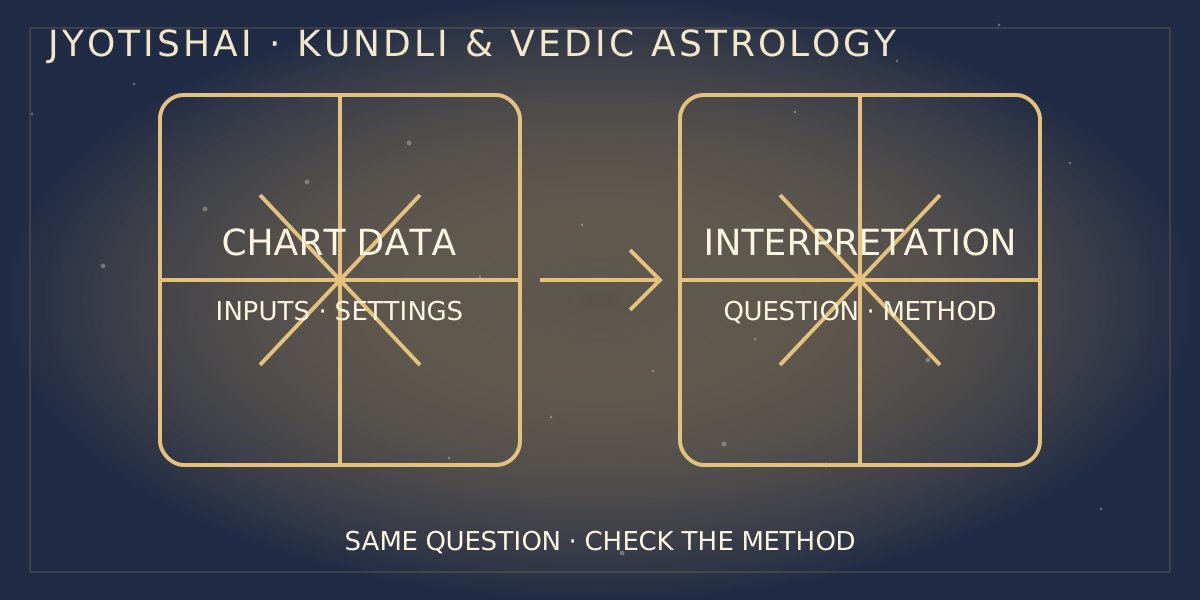
First, check whether both readers used the same chart
Before comparing conclusions, confirm that each astrologer received the same date, local birth time and birthplace. Check time-zone handling and whether a remembered or rounded time was described as uncertain. Then ask which zodiac, ayanamsha, house approach and chart type were used. A difference in the underlying chart is a calculation or input question; a difference in what the same chart means is an interpretation question. Keeping those two issues separate saves time and avoids treating every disagreement as a mystery.
A chart can contain many factors
A Kundli is not a single-sign label. A reader may consider Lagna, houses, house lords, planetary placements, aspects, Nakshatras, divisional charts, dasha periods and transits, depending on the question and method. Two practitioners can give different emphasis to these layers even when the chart image matches. Ask which factors informed the answer and how they relate to your specific question. A short answer that names its basis is easier to evaluate than a sweeping statement about your whole life.
The question can change the focus
“What does my chart say?” is broad. A question about choosing between two job offers, for example, may lead a reader to discuss work-related houses and timing, while a question about communication at home could focus on different themes. That shift in focus does not make the chart itself different. It means the reading is organised around a different concern. Tell the astrologer what decision you are considering, what practical facts you already know and what kind of guidance would actually help.
Tradition and interpretation are not identical
Jyotisha includes calculation and interpretive traditions, and practitioners may be trained in or prefer different methods. Even a shared label such as “Vedic astrology” does not guarantee that every reader applies the same rules in the same order. Astrodienst likewise notes that astrology has no single unified doctrine for how all astrologers read a chart; this is a description of interpretive diversity, not proof that every conclusion is equally sound. A responsible reader should be able to name their approach and acknowledge where judgment is involved.
A respectful way to compare two readings
Write each statement in plain language, then ask what chart factor and method support it. Note any assumptions about the birth time, the chosen chart or the question being answered. Ask what would change the interpretation and what remains uncertain. Compare the reasoning and limits, not just which prediction sounds more vivid or reassuring. If you seek a second opinion, share the same birth data and question, and avoid leading the next reader with the first answer unless you are explicitly asking them to review it.
Keep your choices and boundaries central
Astrology is a traditional interpretive practice, not a guaranteed forecast or a substitute for professional advice. Treat a reading as a prompt for reflection, not an instruction to end a relationship, reject a job, stop medical care or make a financial commitment. You can decline a remedy, ask about its cost and cultural context, or stop a conversation that relies on fear or pressure. Practical evidence, consent and your own priorities remain important whatever the chart discussion says.
Frequently asked questions
Can two astrologers use the same Kundli and still disagree?
Yes. They may emphasise different chart factors, traditions or question-specific themes. Ask each person to explain the method and assumptions behind the reading.
How do I know whether they calculated different charts?
Compare the birth date, local time, birthplace, zodiac, ayanamsha, house method and chart type used by each source.
Should I choose the prediction I like better?
Consider the reasoning and uncertainty, not only whether an answer is comforting. Keep major decisions grounded in practical facts and your own judgment.
Is one astrologer always right?
A reading is an interpretation within a tradition, not a guaranteed account of future events. No astrologer can establish certainty from a chart alone.
Continue learning
Sources and context
- Astrodienst: How astrologers interpret a horoscope
- Oxford Bibliographies in Hinduism: Astrology
- Google Search Central: Creating helpful, reliable, people-first content
Citations provide cultural or practical context; they do not endorse JyotishAI or validate astrological predictions.