The short answer
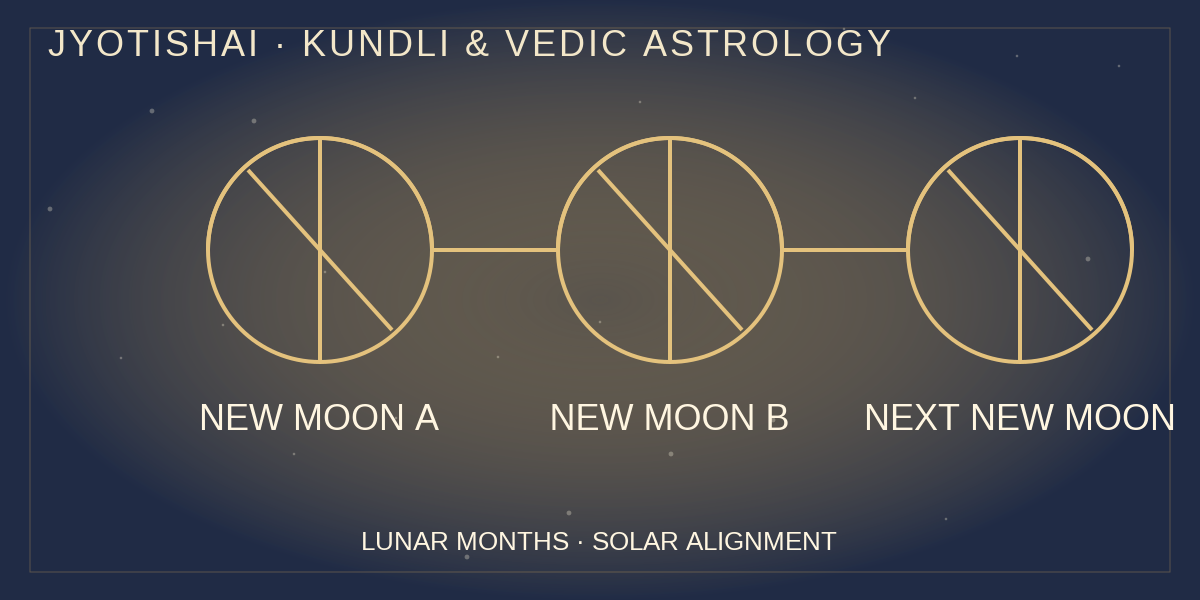
Adhika Maas (also written Adhika Masa or Adhik Mas) is an additional lunar month in a Hindu lunisolar calendar. A lunar year of twelve months is shorter than a solar year, so calendar systems need a way to keep lunar months broadly aligned with the solar cycle and seasons. Under a commonly described rule, when two new moons fall within one solar month, the first corresponding lunar month is marked Adhika and the next is the regular month, often called Nija or Suddha. The exact naming and observance should be read from the specific regional Panchang.
Why an extra month is used
A lunar month follows the Moon’s phases and lasts about 29½ days. Twelve such months do not equal a solar year, so a purely lunar calendar would gradually move through the seasons. The archival study The Hindu Calendar and the astronomical reference Explanatory Supplement to the Astronomical Almanac describe intercalary months as a calendar adjustment. This is a calendrical method, not a prediction about an individual or a sign that the civil calendar has gained an ordinary thirteenth month.
How two months can share a name
Picture two new moons occurring during the same solar month. The lunation that begins with the earlier new moon may carry the prefix Adhika; the following lunation can keep the month name in its regular form. A calendar might therefore show a paired sequence such as “Adhika [month]” followed by the ordinary [month]. The example is a naming pattern, not a date calculation. Check your Panchang’s language and regional convention before comparing month labels with another almanac.
Adhika is not simply “every third year”
The lunar–solar difference makes an extra month recur from time to time, but it is not a fixed Gregorian rule that you can apply by counting three calendar years. Solar ingresses and new-moon boundaries are calculated astronomical events. The reference rules, time standard and chosen month system matter. Use a published Panchang for the year and locality you need; do not use an approximate recurrence to set an observance date.
What changes and what does not
The month label and placement in the calendar sequence are what the intercalation explains. The Moon’s phases, tithis and civil dates still progress; the calendar does not insert weeks of extra time. The same observance can also be described through a different regional calendar or naming convention. When two sources disagree, compare the stated city, date, tithi, month system and source before concluding that one has a mistake.
Religious customs are not identical everywhere
Families and communities may have different customs for fasting, worship, weddings or other activities during an Adhika month. A calendar explanation cannot establish a universal rule for every tradition. If a practice matters to you, ask a trusted local religious authority which calendar and custom they follow. Avoid anyone who uses fear or guaranteed outcomes to pressure you into an expensive ritual, purchase or urgent decision.
A practical checklist for reading a Panchang
First note the year and city. Then identify whether the source uses a lunar or solar month and whether it states Amanta or Purnimanta reckoning. Read the actual month and tithi labels, including any Adhika or Nija prefix, instead of inferring them from an English month. If you are comparing two calendars, line up their dates and observance notes. The India Meteorological Department’s Rashtriya Panchang is one published calendrical reference; regional Panchangs may also explain their own methods.
Use the calendar as cultural context
Learning why an intercalary month appears can make a Panchang easier to read and help explain why a familiar month name seems to repeat. It does not tell you whether a personal choice will succeed. For medical, legal, financial or safety matters, rely on qualified professional advice and practical information. Astrology and calendar traditions can be meaningful to people as cultural or spiritual frameworks, but their interpretations vary.
Frequently asked questions
What does Adhika Maas mean?
Adhika Maas means an additional or intercalary lunar month used in some Hindu lunisolar calendar traditions to keep the calendar broadly aligned with the solar cycle.
Why can a month name appear twice?
In a commonly described method, two new moons can fall within one solar month. The first lunar month may be marked Adhika and the next as the regular or Nija month with the same name.
Does Adhika Maas occur exactly every three years?
No fixed Gregorian interval should be assumed. The timing depends on the solar and lunar boundaries and on the calendar method. Check a published Panchang for the relevant year.
Are the same observance rules followed everywhere?
No. Customs and calendar conventions vary by region and community. Follow the source and trusted local tradition relevant to you.
Continue learning
Sources and context
- S. K. Chatterjee, “Indian Calendars,” Cambridge Core: lunisolar months, Adhika and Kshaya conventions
- The Hindu Calendar, IGNCA: intercalary months and calendrical context
- U.S. Naval Observatory, Explanatory Supplement to the Astronomical Almanac: Indian lunisolar calendar rules
- India Meteorological Department, Rashtriya Panchang
Citations provide cultural or practical context; they do not endorse JyotishAI or validate astrological predictions.