The short answer
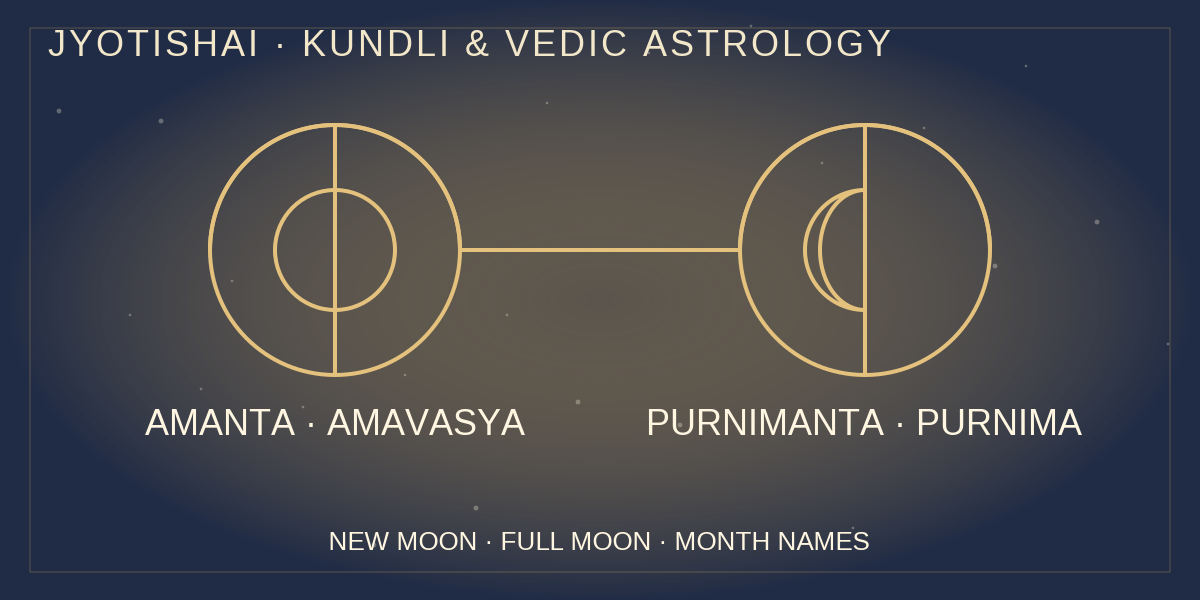
Amanta and Purnimanta are two conventions for where a lunar month ends. Amanta closes the month at Amavasya, the new moon; Purnimanta closes it at Purnima, the full moon. Since the boundary falls at a different point in the lunar cycle, a Krishna Paksha (waning fortnight) can be assigned different month names in the two systems. The Moon phase, tithi and civil date are not changed just because a calendar uses another month label.
How a lunar month is arranged
A lunar month contains Shukla Paksha, the waxing half from new moon toward full moon, and Krishna Paksha, the waning half from full moon toward new moon. The Government of India’s historical work The Hindu Calendar has a dedicated discussion of Amanta and Purnimanta systems and a table mapping their month names. In an Amanta calendar, the month closes with the new moon. In a Purnimanta calendar, it closes with the full moon. That difference moves the month boundary by one paksha, not the underlying sequence of lunar days.
A simple example of the label change
Imagine two calendars showing the same Wednesday and the same waning Chaturthi. One calendar may print “Ashadha Krishna Chaturthi” while another convention can attach a different month name to that same waning-fortnight date. To compare them, line up the Gregorian date, city and tithi first; then check which month-ending convention each calendar uses. Do not conclude that one calendar has moved the festival or miscounted the tithi solely from a different month label. Names and regional practice can vary, so use the particular Panchang’s own legend.
What changes and what does not
The month name can change for the relevant Krishna Paksha when you switch the month-boundary convention. The observable civil date, weekday, lunar phase and tithi do not change merely because a calendar labels the lunar month differently. Other differences between Panchangs can arise from location, time zone, calculation rules, day-boundary choices or from a solar rather than lunar month system. Compare each setting separately instead of treating every disagreement as an Amanta–Purnimanta issue.
India has more than two calendar practices
Amanta and Purnimanta are useful names for two lunar-month conventions, but they do not describe every Indian calendar. The Rashtriya Panchang, published by the Positional Astronomy Centre, was developed in the context of India’s varied calendar practices and uses stated astronomical conventions. Regional calendars may use solar months or combine lunar and solar elements, and local observance customs can differ. Avoid mapping a single system rigidly onto every state, language or family.
How to compare two Panchangs respectfully
Read the date and place at the top of each calendar. Find the paksha and tithi, then the month name and any note such as Amanta, Purnimanta or a solar month. Check the time zone and sunrise or observance rule if the question is about a vrata or festival. If a family or temple follows a particular regional calendar, ask which convention it uses rather than correcting it from a different app. For a religious observance, follow the trusted local tradition and the source’s stated rule.
Use calendar labels as context, not as a verdict
Calendar systems organise time in culturally meaningful ways; learning their labels can explain why two sources appear to disagree. The label alone does not establish whether an activity is auspicious, safe or right for you. If you consult an astrologer or priest about timing, ask which calendar, locality and observance rule they apply, and keep practical constraints and personal judgment in view. Never delay urgent medical care or ignore safety advice because of a calendar label.
Frequently asked questions
What is the main difference between Amanta and Purnimanta?
Amanta ends the lunar month at Amavasya (new moon); Purnimanta ends it at Purnima (full moon). This can give the same waning fortnight a different month name.
Does a different month name mean the tithi changed?
No. A naming convention by itself does not change the tithi, lunar phase, weekday or civil date. Compare those fields separately.
Are all North Indian calendars Purnimanta and all South Indian calendars Amanta?
No simple regional rule covers every community or calendar. Solar and other regional systems are also used; check the named convention and local practice.
Why can two Panchangs still differ after I check the month system?
Location, time zone, calculation settings, sunrise rules, rounding and regional observance traditions may also affect what is printed.
Continue learning
Sources and context
- IGNCA, The Hindu Calendar: Amanta and Purnimanta systems and month correspondence
- India Meteorological Department: Rashtriya Panchang and Positional Astronomy Centre
- IMD Kolkata: Rashtriya Panchanga 2026–27 explanation
Citations provide cultural or practical context; they do not endorse JyotishAI or validate astrological predictions.