The short answer
Atmakaraka—often shortened to AK—is one of the Chara Karakas, or movable significators, used in Jaimini Jyotish. In a commonly used approach, the planet farthest advanced within its sign is assigned the Atmakaraka role. Readers interpret that role symbolically within a larger chart method. It is not an objective measurement of a person’s soul, personality, worth or destiny, and the result can depend on the convention a calculator or astrologer follows.
What “within its sign” means
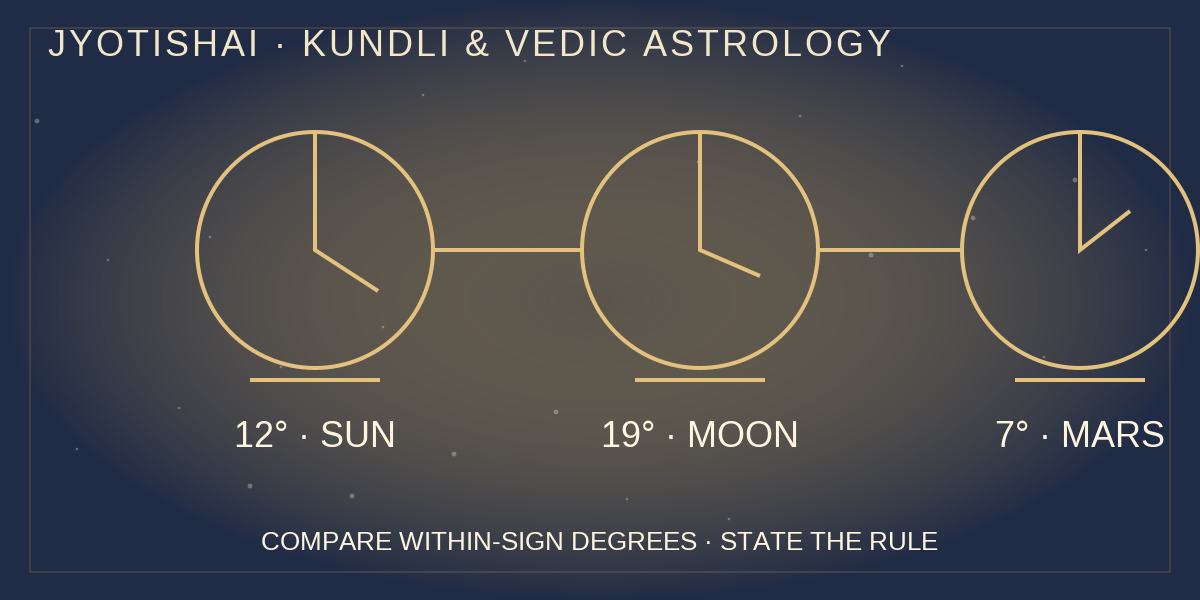
A planet’s longitude is commonly written as degrees, minutes and seconds inside a zodiac sign from 0° to just under 30°. For a simple example, suppose the Sun is at 12° in its sign, the Moon at 19°, Mars at 7° and the other eligible planets are all below 19°. Under a seven-planet method that excludes the lunar nodes, the Moon ranks highest and becomes the Atmakaraka. This is a made-up arithmetic example, not a real birth chart or an interpretation of anyone’s life.
Why software may show a different Atmakaraka
First check the candidate set. Some Jaimini lineages or software settings use the seven visible planets from the Sun through Saturn; others use an eight-karaka scheme that includes Rahu. In the latter method, Rahu is often ranked by a reversed degree convention because it moves retrograde. If Rahu’s adjusted position ranks highest, the chosen rule may change the result. Editions and commentaries can differ in how they explain the sutra, so a trustworthy report names its settings rather than presenting one convention as universal.
A careful way to compare two results
Write down the planet longitudes used, the seven- or eight-karaka selection, the Rahu rule, and whether degrees, minutes and seconds are considered. Make sure both tools use the same birth date, local time, birthplace, zodiac settings and ayanāṃśa. Then compare the result under one stated method. A difference between tools may reflect conventions or input settings; it is not automatically evidence that one chart predicts your life more accurately.
How the role is used in the tradition
Jaimini texts and commentaries discuss Chara Karakas as chart significators, with the Atmakaraka at the leading position in a ranked scheme. Some practitioners use it as one part of a broader interpretation, alongside the sign it occupies and related chart factors such as Karakamsa. These ideas are technical and commentarial readings differ. A short online description cannot replace a complete explanation of which text, translation and method a practitioner is applying.
What it cannot tell you by itself
A single karaka does not provide a complete personality profile or guarantee a career, marriage, spiritual awakening or specific future event. Avoid claims that one placement proves you are selfish, spiritually advanced, destined for a particular partner or required to perform a costly remedy. Ask the astrologer to explain the method and uncertainty in ordinary language. Keep real decisions grounded in your circumstances, preferences and trusted professional advice where needed.
Questions to ask a Jaimini reader
You can ask: “Which Chara Karaka scheme do you use?” “Is Rahu included, and how is it ranked?” “Which Jaimini text or commentary informs your interpretation?” “What other chart factors are you considering?” and “Which parts are symbolic interpretation rather than a calculated fact?” These questions help you understand the reading without needing to accept a dramatic prediction or surrender your own judgment.
Use the concept as a study prompt
If you are learning Jaimini astrology, record the convention before calculating the chart and compare a result with a cited translation or commentary. Treat Atmakaraka as a traditional interpretive concept, not a scientific test or a label that defines who you are. Birth details and chart settings affect calculations; cultural and interpretive traditions vary. Astrology is not a substitute for medical, legal, financial or mental-health advice.
Frequently asked questions
What does Atmakaraka mean in Jaimini astrology?
It is the leading Chara Karaka in a Jaimini ranking scheme. Practitioners interpret it symbolically within a broader method; it does not scientifically measure a soul or determine a person’s worth.
How do I calculate my Atmakaraka?
A common approach compares how far eligible planets have advanced within their signs. State whether your method includes seven planets or Rahu as an eighth candidate, since that choice can affect the result.
Why does one calculator include Rahu?
Some commentarial schemes use an eight-karaka set that includes Rahu; others use seven planets. The treatment and degree convention should be stated rather than assumed to be universal.
Does Atmakaraka predict my future by itself?
No. It is one traditional chart factor, interpreted differently across lineages. It cannot guarantee life events or replace practical judgment and qualified professional advice.
Continue learning
Sources and context
- Rāma Daivajña, Jaimini Sutras: Sanskrit text and translation with notes, Motilal Banarsidass edition record
- B. V. Raman, Studies in Jaimini Astrology, Motilal Banarsidass edition record
- Digitized Jaimini Sutras, Suryanarain Rao translation (consult the edition’s own notes and numbering)
Citations provide cultural or practical context; they do not endorse JyotishAI or validate astrological predictions.