The short answer
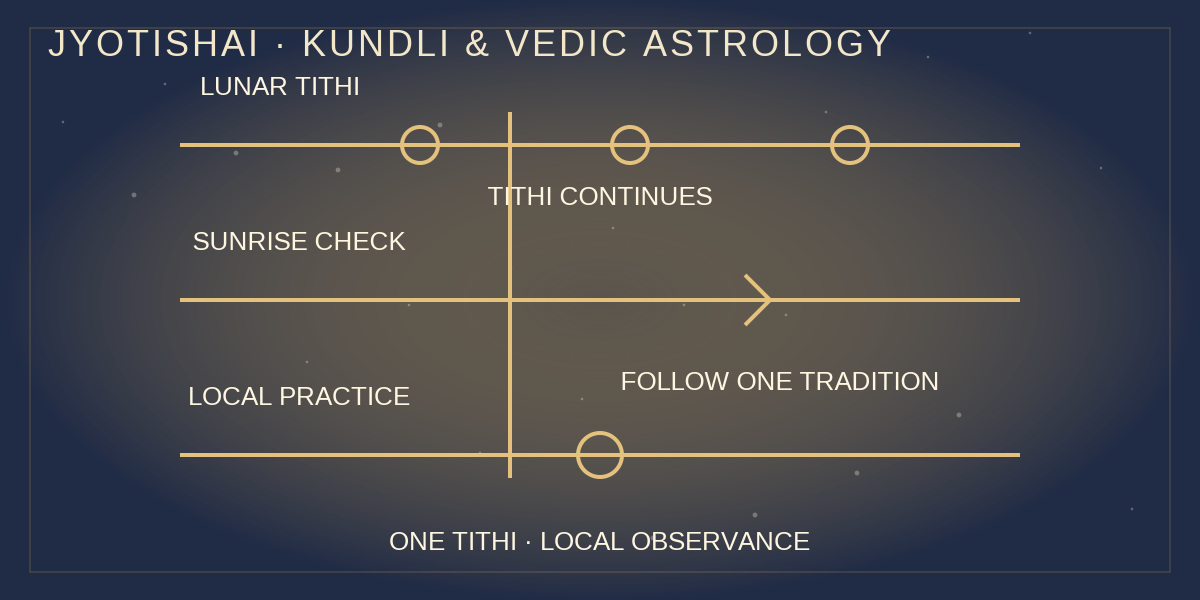
A lunar tithi does not always begin and end neatly at midnight. Panchang observance is commonly worked out against local sunrise and tradition-specific rules, so calendars can label adjacent dates differently. For New Delhi in 2026, Drik Panchang lists Devutthana Ekadashi on Friday, November 20 and a Gauna/Vaishnava observance on Saturday, November 21. That is a concrete example of two labels appearing on consecutive dates; it is not evidence that every region or family must observe both days.
What is a tithi?
A tithi is a lunar day measured from the changing angular relationship between the Sun and Moon. It may begin or end at any clock time, so a civil calendar date and a tithi are not identical units. A local Panchang translates that interval into a date using place-specific sunrise and other calendrical conventions. That is why the city, time zone and the rule set behind a calendar matter when comparing entries.
Why do Smarta and Vaishnava labels differ?
Some calendars distinguish observance conventions associated with Smarta and Vaishnava communities. A tithi’s presence at sunrise, its relationship to the previous or next tithi, and in some Vaishnava calculations a pre-sunrise interval called arunodaya can affect the chosen observance day. The exact method and names can vary across calendars and sampradayas, so a short web snippet should not be treated as a universal rulebook. The useful first question is: which local temple or family calendar is this calendar representing?
How to compare two dates without getting confused
First compare the same city and time zone. Then read the complete entry: the tithi start and end, sunrise, the named observance, and whether the page explicitly says Smarta, Vaishnava or Gauna. Do not compare one city’s date with another city’s timings or mix a sunrise-based calendar with a global timestamp. If you observe a fast, use the calendar and guidance followed by your household or temple.
A practical example from November 2026
The New Delhi listing for Prabodhini/Devutthana Ekadashi shows the main Devutthana observance on November 20, 2026 and a Gauna Devutthana entry on November 21. The same calendar lists the tithi interval crossing from November 20 into the early hours of November 21. This illustrates why one page may foreground the main date while another lists a second community observance. It does not establish that either date is right for every location or lineage.
If you are new to Ekadashi observances
You do not need to resolve every calendrical disagreement before learning what the festival means. Ask a trusted local temple or family elder which Panchang tradition they follow, and use that same source consistently. Fasting practices are personal and may not suit everyone; health, medication, pregnancy, age and other needs come first. This guide explains calendar labels, not religious obligations or medical advice.
Use a calendar as cultural guidance, not a guarantee
Panchang conventions are part of living regional and religious traditions. Dates are calculated for a place and may differ across methods; astrological interpretations are not guaranteed predictions. For health concerns or other important decisions, use appropriate professional advice alongside any cultural practice.
Frequently asked questions
Why does my app show Ekadashi on a different day?
Check that both entries use the same city and identify the same tradition. Sunrise rules, a tithi crossing midnight, and community-specific observance conventions can produce adjacent dates.
Does “Gauna Ekadashi” mean the first date is wrong?
No. Some calendars use Gauna for an additional observance date under a particular rule or community practice. Follow the local tradition you observe rather than combining labels from unrelated calendars.
Should I fast on both listed dates?
This page does not prescribe fasting. Ask the temple or family authority you follow, and put your health and medical needs first.
Does the New Delhi date apply throughout India?
No. A Panchang date is place-sensitive. Check a calendar configured for your city and your community’s convention.
Continue learning
Sources and context
- Drik Panchang, 2026 Prabodhini Ekadashi for New Delhi: dated Devutthana and Gauna/Vaishnava entries
- Drik Panchang, 2026 Ekadashi dates for New Delhi: location-based calendar
- Shastra Panchangam, Ekadashi calculation overview: community conventions (secondary explainer)
- Google Search Central, creating helpful and reliable people-first content
Citations provide cultural or practical context; they do not endorse JyotishAI or validate astrological predictions.