The quick answer
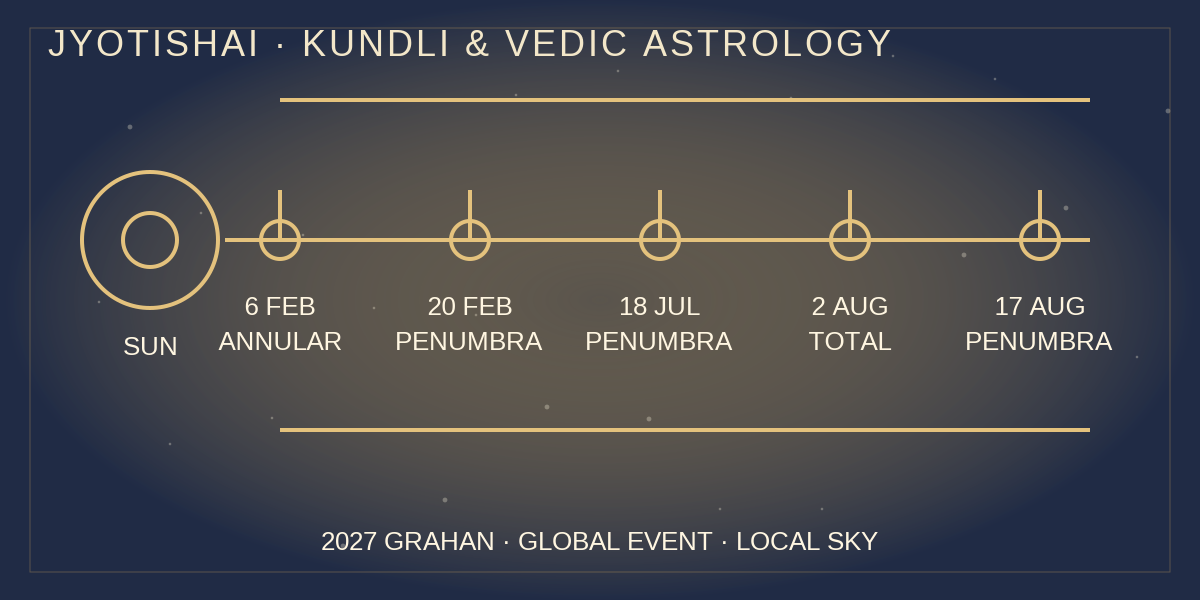
NASA’s 2027 catalog lists five eclipses: an annular solar eclipse on February 6, penumbral lunar eclipses on February 20, July 18 and August 17, and a total solar eclipse on August 2. “Total” or “annular” describes the event somewhere along its path, not what every observer will see. In Delhi, the August 2 event is listed as partial; exact visibility and local times depend on the city. Use an astronomy calendar for your location before making plans.
All five events at a glance
February 6 — annular solar eclipse; the India Meteorological Department’s Rashtriya Panchang says this event is not visible in India. February 20 — penumbral lunar eclipse; worldwide calendars may show February 20–21 because the event crosses time zones, and Delhi’s local detail page labels the view on February 21. July 18 — penumbral lunar eclipse. August 2 — total solar eclipse along a narrow path elsewhere, with a partial event listed for Delhi. August 17 — penumbral lunar eclipse. These are event dates, not a promise that the eclipse is visible from your neighbourhood.
Why one eclipse can have two dates
Astronomy catalogs commonly express eclipse calculations in Universal Time, while an Indian viewer follows Indian Standard Time and a local horizon. An event late in the day in one time zone may fall after midnight in another. NASA’s catalog and public overview identify the worldwide events; a location calendar converts the relevant phases to the selected place. That is why a headline may say February 20 while a Delhi viewing page shows February 21. Check the time zone printed beside the time, not just the date in a search snippet.
What “visible in India” actually means
Visibility is local. A solar eclipse may be below the horizon for one city, visible only in a partial phase elsewhere, or not visible at all. A penumbral lunar eclipse can be so subtle that many viewers will not notice a change. The Delhi calendar currently lists the February 2027 penumbral lunar event and the August 2027 partial solar event; that list describes Delhi, not every Indian state. Select your own city and confirm the sunrise, sunset and eclipse phases close to the event.
Reading a Panchang entry without mixing systems
A Panchang may give a traditional tithi or ritual context; an astronomical catalog gives eclipse contacts and visibility. They answer related but different questions. The Rashtriya Panchang’s 2026–27 eclipse page, for example, lists the February 6, 2027 annular eclipse as not visible in India, but it covers a Saka-year span rather than acting as a complete January-to-December 2027 city-by-city viewer. For a local sky plan, pair the relevant Panchang tradition with an eclipse path or city calendar.
A simple planning checklist
First choose the city where you will be. Then check whether the Sun or Moon is above the horizon during the event, whether the eclipse is actually visible there, and whether the listed times use IST or another zone. For a solar eclipse, read the safety instructions before observing; a partial eclipse still needs safe solar viewing protection. If you are asking about a religious observance, check the Panchang and family or temple practice you follow rather than assuming a single nationwide rule from a global event date.
Use dates as a guide, not a prediction
Eclipse calendars describe repeatable astronomical geometry. They do not establish that an eclipse guarantees a personal event, danger or outcome. Astrological interpretations and observances differ among schools, regions and families. Treat any Jyotisha reading as cultural or spiritual reflection, and do not let it replace practical planning or professional medical, legal or financial advice. Recheck the city-specific calendar nearer the date because viewing details are what matter for an actual plan.
Frequently asked questions
How many eclipses are listed for 2027?
NASA lists two solar and three lunar eclipses in its 2027 catalog. A local viewer may show fewer because not every eclipse is visible from every place.
Is the August 2, 2027 solar eclipse total in India?
No. Totality follows a narrow path outside India. Timeanddate lists a partial solar eclipse for Delhi; use a city-specific page for your location.
Why do some calendars show February 20 and others February 21?
They may be displaying Universal Time or local Indian time. The penumbral lunar event crosses the date boundary between zones.
Does the 2026–27 Rashtriya Panchang list every 2027 eclipse?
Its eclipse page is for the 1948 Saka year (2026–27) and lists events in that span. It is not a complete Gregorian 2027 city visibility calendar.
Continue learning
Sources and context
- NASA, Eclipses During 2027: the five-event catalog and Universal Time basis
- NASA Science, Future Eclipses: event types and worldwide visibility regions
- India Meteorological Department, Rashtriya Panchang: eclipse list for Saka 1948 / 2026–27
- Timeanddate, eclipses visible from Delhi and local event pages
- AstroSage, 2027 eclipse calendar: competitor example for India-focused query intent
- Google Search Central, helpful and reliable people-first content
Citations provide cultural or practical context; they do not endorse JyotishAI or validate astrological predictions.