Who are Rahu and Ketu?
In Jyotisha, Rahu and Ketu are the north and south lunar nodes, the points where the Moon’s orbital path crosses the apparent path of the Sun. They are not physical planets like Mars or Jupiter. Traditional chart systems assign them symbolic meanings and interpret them through their positions and relationships.
Why astrologers often read them together
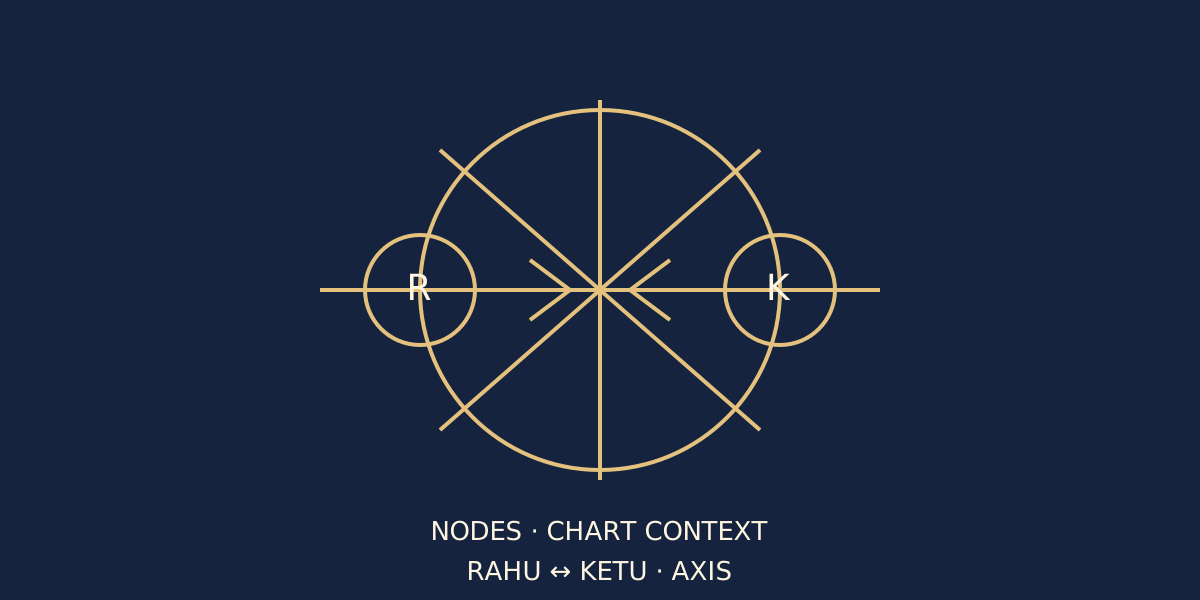
Rahu and Ketu lie opposite each other in a birth chart, forming an axis across two signs and houses. A reading may discuss contrast, attention, attachment or areas of experience associated with those chart sectors. The language and emphasis vary by school. One node should not be interpreted in isolation from the rest of the chart.
What a responsible interpretation should explain
Ask which house system and chart calculation are being used, which houses the nodes occupy, which planets rule those signs, and what other factors support the interpretation. A thoughtful astrologer can distinguish a traditional symbolic reading from a factual claim about what must happen in your life.
Avoid frightening one-line claims
Statements that Rahu or Ketu guarantee illness, divorce, financial loss or a curse are not reliable evidence. They can create unnecessary anxiety. Do not make a medical, legal, financial or relationship decision solely because of a node placement. Seek qualified support when the decision calls for it.
Use the axis as a reflection prompt
If a chart discussion raises a theme, turn it into a question: What am I focusing on? Where might I need balance? What action is within my control? Reflection can be useful without treating an astrological symbol as a diagnosis or destiny.
Check birth details and chart settings
The house placement can depend on birth time, location and calculation choices. If your birth time is uncertain, tell the reader. Ask whether the result uses mean or true nodes if that distinction matters to the method being applied.
Frequently asked questions
Are Rahu and Ketu planets?
They are mathematical points called lunar nodes, not physical planets. Jyotisha nevertheless gives them a symbolic role in chart interpretation.
Is Rahu always bad and Ketu always good?
That good-versus-bad shorthand is too simple. Traditional readings vary and consider the full chart and interpretive school.
Can Rahu or Ketu predict a specific event?
A placement cannot prove that a particular event will occur. Treat specific claims as interpretation, not certainty.