The short answer
Saptamsa, also written Saptamsha or Saptāṁśa, is the D7 divisional chart in a family of charts used in Jyotisha. In the Brihat Parashara Hora Shastra (BPHS), the Saptamsa is connected with “sons and grandsons,” a phrase commonly discussed today as children and the next generation. That is a description of a traditional interpretive scope, not evidence that a horoscope can diagnose infertility, predict a pregnancy, or determine a child’s future.
How a D7 chart is formed
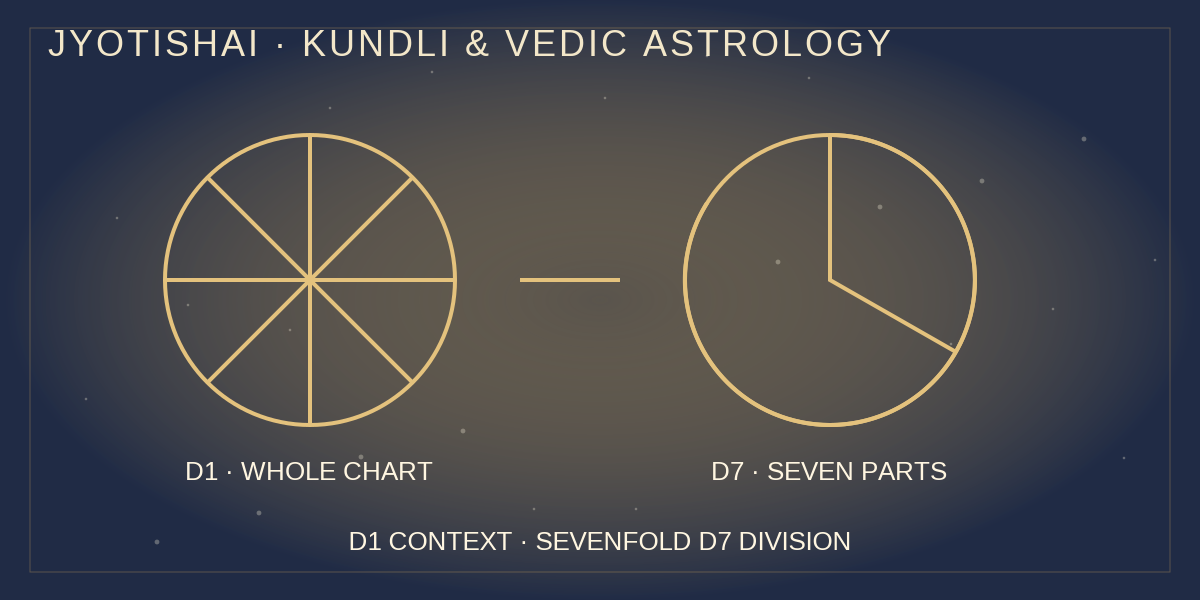
The name refers to dividing each 30-degree zodiac sign into seven equal portions, each about 4 degrees and 17 minutes wide. BPHS chapter 6 gives a counting convention: for an odd sign, the sequence begins with that sign; for an even sign, it begins from the seventh sign from it. A chart program maps each planet’s longitude through that convention to create another chart. This is a derived symbolic chart, not a separate observation of the sky. Other calculation settings or traditions may explain details differently, so ask which method a reader used.
Why the main birth chart still matters
A responsible traditional reading does not treat one D7 placement as a verdict. The reader should explain how the D7 relates to the Rashi or D1 chart and to the astrologer’s chosen Jyotisha framework. BPHS chapter 7 assigns the Saptamsa a topic, but modern practitioners may differ about which houses, planets, timing systems or additional charts they consider. A useful consultation makes those assumptions visible instead of saying that one planet or one score settles a personal question.
What Saptamsa cannot tell you
A D7 chart cannot establish whether someone can conceive, how many children they will have, a child’s sex, pregnancy outcomes, or the health of a parent or child. Those are not reliable conclusions to draw from an astrological chart. If you have fertility, pregnancy or child-health questions, speak with a qualified medical professional. A reading must never delay testing, treatment or urgent care. No one should use a frightening D7 interpretation to pressure a family into a costly puja, gemstone or other purchase.
A practical example of a careful reading
Imagine a couple discussing whether they want to become parents. An astrologer may explain that some Parashari traditions include D7 as one symbolic lens, while also clarifying that the chart does not answer a medical question or make the choice for them. The couple can ask about their values, support network, finances and readiness, and seek clinical advice when relevant. This example does not calculate a chart or promise an outcome; it shows how cultural reflection can sit alongside real-world information and personal choice.
Questions to ask an astrologer
Before relying on a D7 interpretation, ask: Which text or school informs your approach? What birth-time and location did you use? How did you derive the D7, and which other chart factors did you consider? Which parts are traditional interpretation rather than a calculation? What is uncertain? Does your suggestion involve a paid remedy, and is it genuinely optional? A clear practitioner should welcome these questions, respect privacy and avoid claiming that a chart can replace a doctor or a family’s own decision.
Use the chart as cultural context, not a verdict
Families engage with Jyotisha in different ways, and people may choose to include or leave out chart readings in decisions about parenthood. A D7 discussion can help someone understand one textual tradition or prepare questions for a consultation. It should not create fear, assign blame, or imply that a person’s worth depends on having children. Keep the conversation respectful, voluntary and grounded in the needs and choices of the people involved.
Frequently asked questions
What does Saptamsa (D7) mean?
Saptamsa is the seventh divisional chart in Jyotisha. BPHS describes it in connection with children and descendants; interpretations and uses vary among practitioners.
Can a D7 chart predict pregnancy or fertility?
No reliable medical conclusion can be drawn from D7. For fertility, pregnancy or child-health concerns, consult a qualified medical professional.
Does Saptamsa work without an exact birth time?
The chart depends on birth details and calculation settings. If the time is uncertain, tell the astrologer and ask how that affects their interpretation rather than treating the output as precise.
Should I buy a remedy after a worrying D7 reading?
No purchase is required by a chart. Remedies should be voluntary, affordable and explained without threats or guarantees.
Continue learning
Sources and context
- Brihat Parashara Hora Shastra, chapter 6: sixteen divisions of a sign
- Brihat Parashara Hora Shastra, chapter 7, verses 1–5: traditional topics assigned to divisional charts
- ePandit, Saptamsa (D7): chart method, traditional scope and limitations
- Google Search Central, creating helpful, reliable, people-first content
Citations provide cultural or practical context; they do not endorse JyotishAI or validate astrological predictions.