The rule that prevents eye injury
Except during the brief totality of a total solar eclipse, never look directly at the Sun without specialized solar-viewing protection. If your location sees only a partial eclipse, there is no totality break: protection stays on for every direct view. The August 2, 2027 eclipse is total along a narrow path elsewhere, but Timeanddate lists it as partial in Delhi. Check your own city; do not assume that a headline about a “total eclipse” means totality where you are.
Choose a safe direct-view viewer
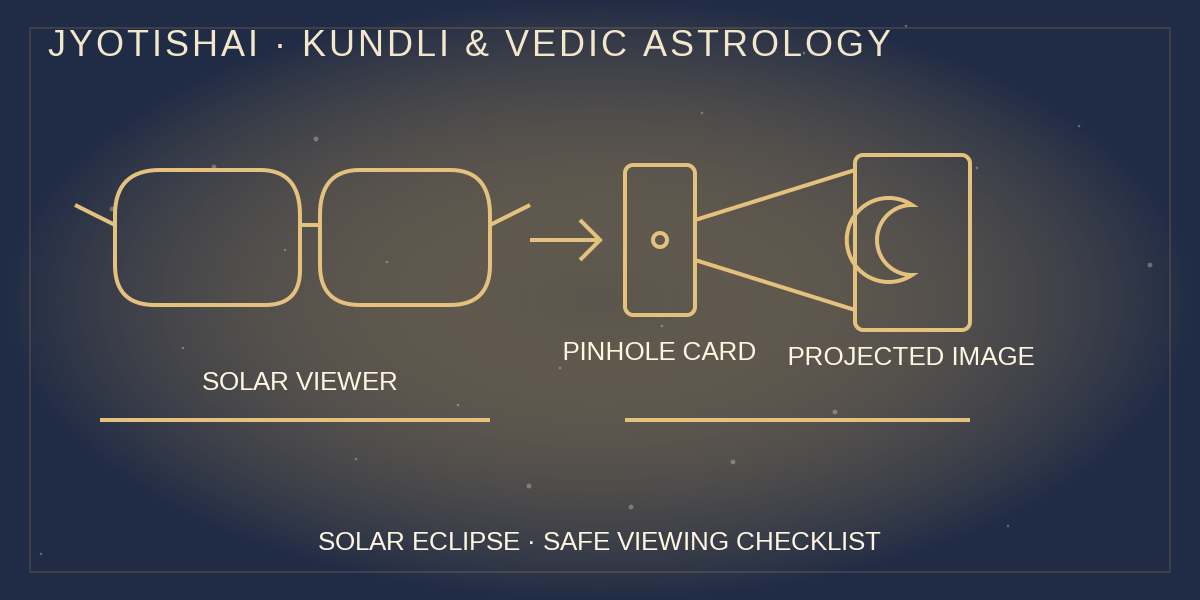
Use solar-viewing glasses or a handheld solar viewer that complies with ISO 12312-2, the international standard NASA points viewers to. Ordinary sunglasses are not safe, however dark they look. Check the viewer before use: discard it if the filter is scratched, punctured, torn or loose. Follow the manufacturer’s instructions, keep the viewer in place while facing the Sun, and supervise children. A printed standard mark alone cannot establish that a seller is trustworthy, so use a reputable source and avoid improvised filters.
Never point unfiltered optics at the Sun
Do not look at the Sun through a camera, phone attachment, binoculars or telescope while wearing eclipse glasses. Magnifying optics concentrate sunlight and can damage the filter and eyes. Telescopes, binoculars and camera lenses need a purpose-built solar filter securely mounted over the front aperture, between the optics and the Sun. If you are unsure whether a filter is designed for your instrument or correctly fitted, do not use that instrument for solar viewing. An astronomer or astronomy club can advise on equipment.
Try indirect projection instead
A pinhole projector lets you watch a small image of the Sun projected onto a surface without looking at the Sun itself. Stand with your back to the Sun, let light pass through a small pinhole in card, and observe the projected image on another card or wall. Do not look through the pinhole. A colander can also project many small crescent-shaped images during a partial eclipse. NASA’s box-projector instructions offer a more enclosed design; an indirect viewer should remain pointed away from your eyes and the Sun.
A practical viewing checklist
Before the date, confirm that the eclipse is visible from your city and check the local start and end times. Inspect your viewer in good light before leaving home; bring a backup indirect method; explain the no-bare-eye rule to children; and do not handle optical equipment without its correct front-mounted filter. If clouds cover the Sun, do not use a camera zoom to “see through” them. The event remains interesting through a projected image or a reliable live stream.
What totality does—and does not—change
Only observers inside the narrow path of a total solar eclipse can remove eye protection during the short interval when the Moon completely covers the Sun’s bright face. They must put protection back on as soon as any bright part reappears. This exception does not apply to annular or partial eclipses, and it does not apply outside the path of totality. For the 2027 event, viewers in Delhi see a partial eclipse according to the local listing, so they should keep solar protection on for every direct look.
Keep astronomy and Jyotisha in their lanes
Eclipse dates and viewing paths come from astronomical calculations; religious observances and Jyotisha interpretations are cultural traditions that vary. Neither a spiritual practice nor a timing recommendation changes eye-safety requirements. Do not risk eyesight for a photograph or a ritual. This article is general viewing information, not medical advice; follow official eye-safety guidance and consult an eye-care professional if you have a concern.
Frequently asked questions
Can I watch a partial solar eclipse with sunglasses?
No. Regular sunglasses, including very dark ones, do not provide safe solar viewing. Use a compliant solar viewer or an indirect projection method.
Can I use eclipse glasses with binoculars or a telescope?
No. Solar viewers are not designed for magnified optics. Those devices need a correct solar filter securely mounted over the front aperture.
Can a pinhole projector be used to see the Sun directly?
No. Look only at the projected image on a surface, with your back to the Sun. Never look through the pinhole.
Will India see the August 2027 eclipse as total?
Totality is confined to a narrow path outside India. The Delhi city listing shows a partial eclipse; check the local listing for your own city.
Continue learning
Sources and context
- NASA Science, Eclipse Viewing Safety: eye protection, optical filters and projection
- American Astronomical Society, safe solar viewers and ISO 12312-2 guidance
- NASA Science, 2027 eclipse dates and worldwide path information
- Timeanddate, August 2, 2027 partial solar eclipse in Delhi, India
- Google Search Central, helpful and reliable people-first content
Citations provide cultural or practical context; they do not endorse JyotishAI or validate astrological predictions.