The short answer
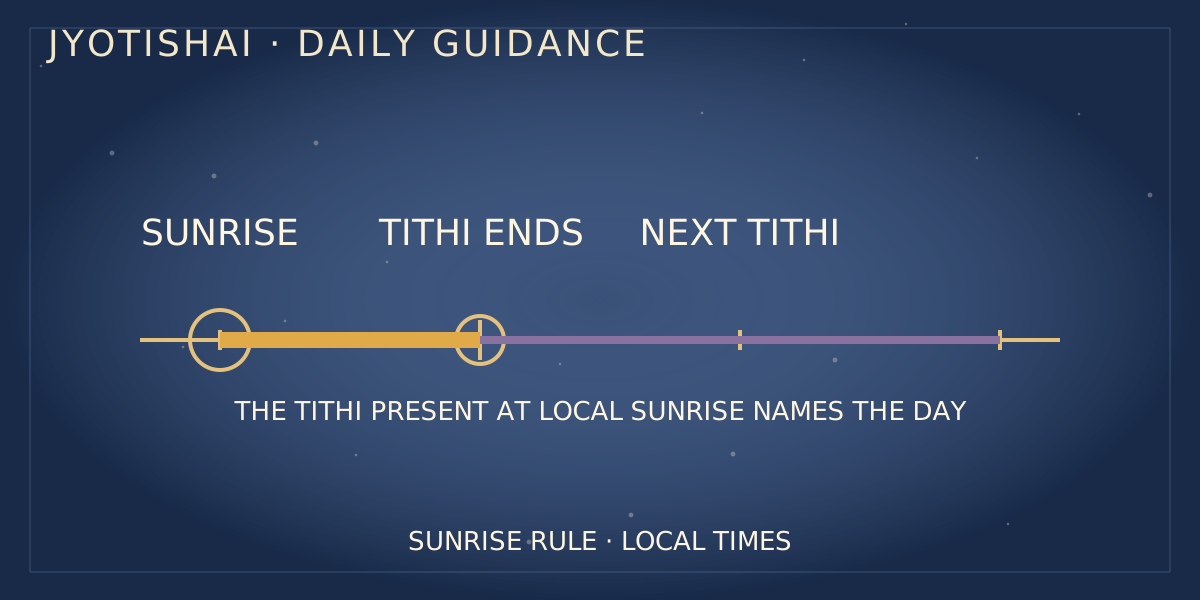
A civil calendar date usually runs from midnight to midnight. A tithi is a traditional lunar-calendar period that can begin or end at another time. Many daily Panchang tables name the tithi that is present at local sunrise and show when that tithi ends. So an entry such as “Tithi A until 6:42 am” can mean that Tithi A was present at sunrise and ends later that morning; Tithi B begins after that time. The label does not mean that the tithi started at midnight, and the exact observance rule for a festival can require an additional check.
What “tithi at sunrise” means
In many Panchang conventions, the tithi present at sunrise is used to name the ordinary calendar day. This gives a consistent reference point because tithis do not line up exactly with midnight on a civil clock. If the tithi changes after sunrise, a second tithi may occupy much of the remaining daylight while the day’s Panchang heading still names the one that was present at sunrise. This is a customary calendar convention; different calendars can explain or apply rules differently, so check the method provided by the Panchang you use.
How to read a “tithi until” time
Start with the city, date and time zone at the top of the Panchang. Find the tithi line and check whether its time is an end time. If the line says “Tithi A until 6:42 am,” compare that end with the local sunrise printed for the same location. When Tithi A is present at sunrise and ends at 6:42, the next tithi begins at that time. Do not read the clock time as the start of the named tithi. Some almanacs use different display conventions, so their legend or FAQ is important.
Why location can change the day label
Sunrise is local. Two cities can have different sunrise times on the same civil date, and a tithi boundary may fall between those sunrise moments. Their Panchang day labels can therefore differ under a sunrise-based convention. Time-zone settings also matter when a calendar displays local times for a location outside your own. Use the city where the observance or activity will take place rather than copying a time from a different city, a screenshot or a family message without checking its location.
Why festival dates need more than the daily label
The sunrise rule is not the only consideration used for every festival. A vrata or festival may follow a tradition-specific observance window associated with sunrise, midday, sunset or midnight. Calendars may also explain overlap or skipped/repeated tithi situations differently. That is why two observances connected with the same tithi can appear on different civil dates. For an important religious observance, consult a trusted local Panchang or the practice followed by your family or temple; do not infer a festival date from one general daily line alone.
A careful example
Suppose your local Panchang lists “Tithi A until 6:42 am” and local sunrise is 6:18 am. Under a sunrise-based daily naming rule, Tithi A is the tithi present at sunrise, even though it ends 24 minutes later. Tithi B then begins at 6:42 am. This example shows how to read a displayed boundary; it is not a date calculation for any real city or festival. If the printed sunrise is for another location, or the source labels times as starts instead of ends, the conclusion could change.
A quick Panchang reading checklist
Confirm the selected city, date and time zone. Read the legend to learn whether the listed time marks a start or an end. Compare the tithi boundary with that city’s sunrise if you are trying to understand the day label. For a festival or vrata, check the observance rule and local tradition separately. If two trusted calendars differ, compare their location, calculation method and festival convention before deciding that one must be wrong. Treat the Panchang as a cultural calendar aid and keep practical plans, safety and personal judgment in view.
Frequently asked questions
Does a tithi change at midnight?
Not necessarily. A tithi can begin or end at any clock time, so it may cross a midnight boundary or change during the day.
What does “Dashami until 7:00 am” mean in a Panchang?
Check the source’s convention. Many daily Panchangs list the end time of the tithi that was present at sunrise; the next tithi begins after the stated time.
Why do two cities show different tithis on the same date?
Local sunrise can fall on different sides of a tithi boundary. Location and the calendar’s stated convention both matter.
Is the sunrise tithi always the festival date?
No. A festival may use an observance rule tied to a particular time of day and a local tradition. Check a trusted local calendar for the specific observance.
Continue learning
Sources and context
- Drik Panchang: Reading Panchang start and end timings
- KaalPanchang: The tithi at sunrise and daily naming convention
- Google Search Central: Creating helpful, reliable, people-first content
Citations provide cultural or practical context; they do not endorse JyotishAI or validate astrological predictions.