What Yogini Dasha is
Yogini Dasha is a planetary-period system discussed in Jyotisha. In the BPHS chapter 46 digital edition cited below, verses 196–200 name eight Yoginis, link them to grahas, describe a nakshatra-based starting method and assign period lengths from one through eight years. Other books, editions, teachers and software may number chapters or explain the method differently. This is a traditional timing framework, not a verified forecast of life events.
The eight names and traditional sequence
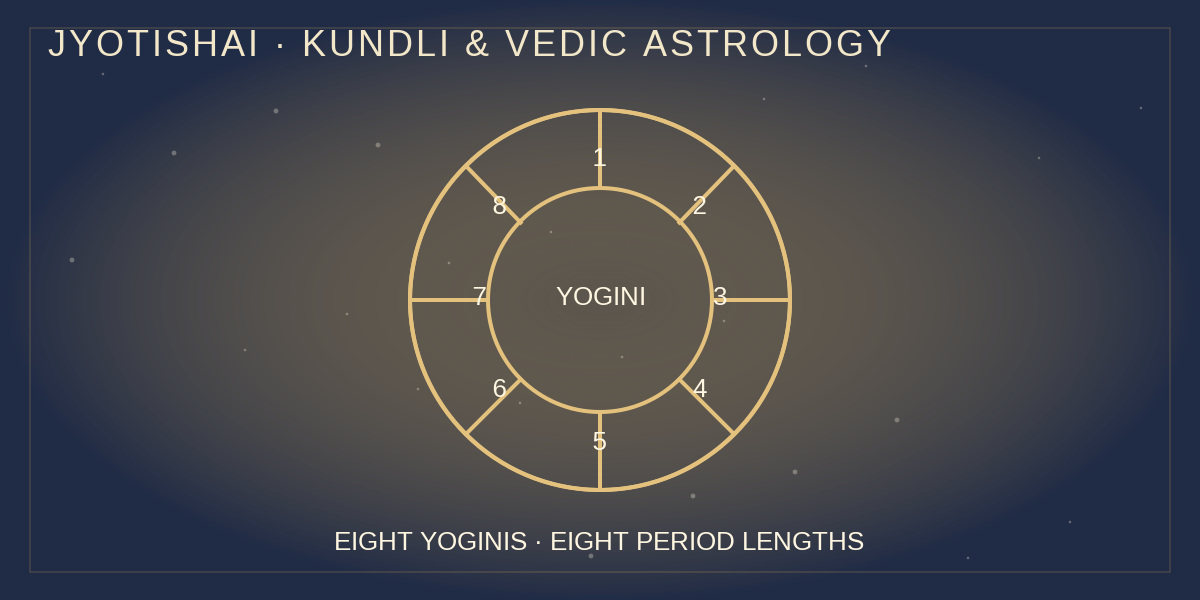
The sequence named in that edition is Mangala, Pingala, Dhanya, Bhramari, Bhadrika, Ulka, Siddha and Sankata. The following verses associate them in order with the Moon, Sun, Jupiter, Mars, Mercury, Saturn, Venus and Rahu. Their period lengths are one, two, three, four, five, six, seven and eight years, completing a 36-year cycle. Spellings differ across transliteration systems, so a chart report may use alternate forms such as Mangala/Mangal or Sankata/Sankat.
How one textual starting method works
The cited BPHS 46.199 explanation adds three to the birth-nakshatra number, divides by eight and uses the remainder to identify the starting Yogini, with the sequence beginning at Mangala. A remainder convention must define what happens when the division is exact; software may encode that convention differently. The next verse derives elapsed and remaining period from how much of the birth nakshatra has passed. This outline explains the linked text, not a personal calculation, and does not establish that every practitioner follows precisely this method.
How it differs from Vimshottari
Both systems use birth-nakshatra context in common Jyotisha approaches, but their sequences and cycle lengths differ. The BPHS describes Vimshottari as a principal system and separately names Yogini among other dashas. Many modern practitioners prioritize Vimshottari, while some use Yogini as an additional lens or within a particular school. A responsible reader should explain why they selected a system for a question rather than presenting one as universally correct or as an independent confirmation of a prediction.
A practical way to compare two reports
Suppose one calculator shows a different current Yogini period from another. First compare the birth date, local time, birthplace and source of the recorded time. Then check the nakshatra calculation, the version or rule set, how remainders are handled, and the convention for elapsed nakshatra portion. Ask whether both tools use the same period-year convention and time zone. If the method is still unclear, treat the dates as uncertain rather than choosing whichever interpretation feels most reassuring or alarming.
Questions to ask in a reading
Ask which text or teaching tradition informs the calculation, which verse or rule determines the first Yogini, how the software treats a zero remainder, and how the birth-time accuracy affects the start and end dates. Ask whether the astrologer uses Yogini alongside Vimshottari and the wider chart, and what remains uncertain. Avoid anyone who claims that a period guarantees marriage, illness, money or loss, or uses a frightening prediction to sell a costly ritual or gemstone.
Keep timing symbolic, not deterministic
A dasha period is part of a traditional interpretive practice. It cannot guarantee a job, relationship, health event or spiritual outcome. Use a reading as optional cultural reflection and keep choices with the people affected. For health, legal or financial decisions, consult qualified professionals and current evidence. Any devotional practice should be voluntary and should never be presented as a substitute for appropriate care.
Frequently asked questions
How many years is a Yogini Dasha cycle?
The cited BPHS passage assigns one through eight years to its eight Yoginis, which total 36 years. Check the source edition and method used by a particular calculator.
What are the eight Yoginis in order?
The cited sequence is Mangala, Pingala, Dhanya, Bhramari, Bhadrika, Ulka, Siddha and Sankata. Spellings vary in transliteration.
Is Yogini Dasha more accurate than Vimshottari?
There is no objective evidence establishing that one astrological system is more accurate. Traditions and practitioner methods differ; ask why a reader chose a particular system.
Why do Yogini Dasha calculators disagree?
Different text editions, starting rules, remainder conventions, birth-time inputs, time zones and period-year conventions can affect dates. Compare the settings before interpreting the result.
Continue learning
Sources and context
- Brihat Parashara Hora Shastra, chapter 46: planetary dasha periods and multiple systems
- Brihat Parashara Hora Shastra 46.196: names of the eight Yoginis
- Brihat Parashara Hora Shastra 46.197–198: graha associations
- Brihat Parashara Hora Shastra 46.199–200: starting method and periods
- AstroTalk Dasha calculator: current consumer tool and introductory claims
- Google Search Central, creating helpful, reliable, people-first content
Citations provide cultural or practical context; they do not endorse JyotishAI or validate astrological predictions.