The short answer
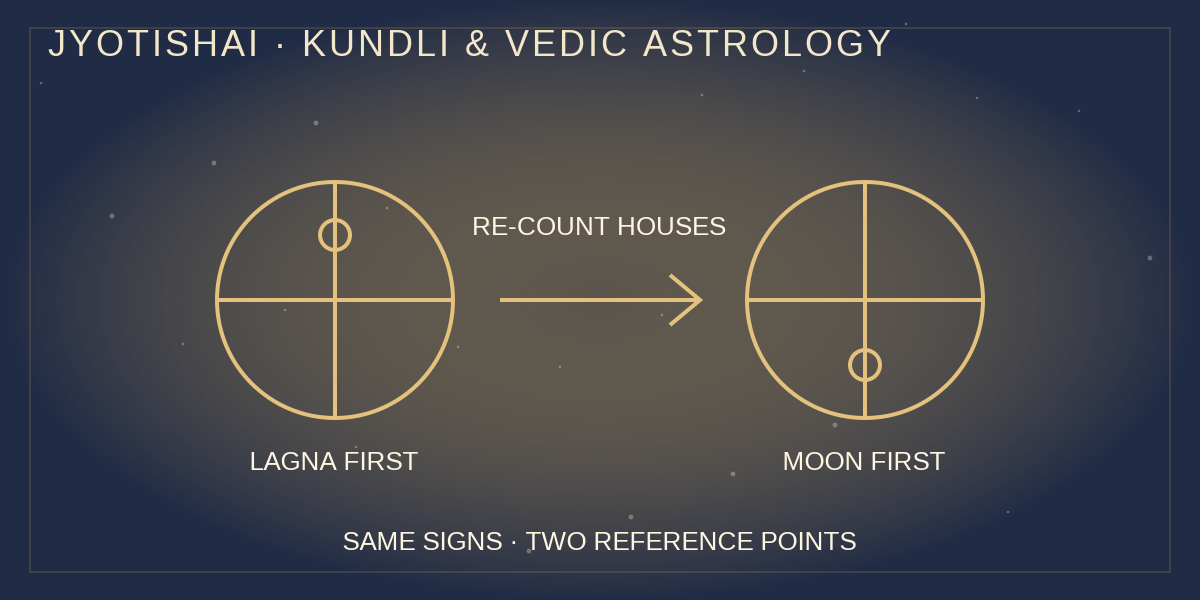
The Lagna chart starts counting houses from the rising sign at birth. A Chandra Kundli (Moon chart or Chandra Lagna) starts the house count from the sign occupied by the Moon. In the traditional Sudarśana Chakra passage of the Bṛhat Parāśara Horā Śāstra, chapter 51, the chart is described with circles reckoned from the birth Lagna, Moon and Sun. A Chandra chart is therefore another reference view of the same birth placements, not a second birth chart with different planets.
What stays the same and what changes?
The planets keep their natal zodiac signs; the house numbers are recounted from a different starting sign. For example, in a clearly hypothetical whole-sign illustration, imagine a chart with Aries rising and the Moon in Cancer. In the Lagna view, Aries is the first house; in the Moon view, Cancer is the first. The signs and planets have not moved. This example explains the counting method only; it does not describe a real person or predict a life event.
Why astrologers may consult the Moon chart
Some Jyotisha traditions use the Moon as an additional reference when examining transits, lived experience or particular yogas. The classical Sudarśana framework itself describes looking from Lagna, Moon and Sun. How much weight to give each view varies by school and question. A responsible reading should say which reference point is being used instead of quietly switching between Lagna and Moon houses.
Why the Lagna chart still matters
The rising sign depends on the birth time and place because the ascendant is tied to the local horizon. Even a small time correction can matter near a sign boundary. The Moon sign usually changes less frequently, but it can still be uncertain if birth details are incomplete and the Moon was near a boundary. If the birth time is unknown, ask the chart provider what can be calculated reliably and what is only approximate.
A simple way to read the two views
First confirm the birth date, time, place, zodiac and house system shown on the chart. Find the Lagna sign and identify the Moon’s sign. Read the Lagna chart as the primary structural view in the method you follow; then, if relevant, re-count from the Moon and note where a traditional interpretation agrees or differs. Ask what textual or school-based rule supports the interpretation. Do not treat a single Moon-chart placement as a standalone verdict.
Avoid mixing chart views
A planet can be in the same zodiac sign but occupy different numbered houses when you change the reference point. If a report says “Saturn in the 7th,” ask: seventh from which starting sign? Is it the birth Lagna, Moon, or a divisional chart? Clear labels prevent confusion when comparing a report, an astrologer’s explanation and an online chart.
Traditional framework, not a proven prediction method
Lagna and Chandra chart reading are parts of Jyotisha, a historical astrological tradition. They are not scientifically established methods for determining personality or guaranteeing future events. Use the chart as cultural or spiritual reflection, and rely on practical information and qualified professional advice for important health, legal or financial decisions.
Frequently asked questions
Is a Chandra Kundli the same as a Lagna chart?
No. It keeps the same birth placements but counts houses from the Moon sign instead of the rising sign.
Do planets move when I open the Moon chart?
No. In a standard Chandra Lagna view the planets remain in their natal signs; the reference point for house counting changes.
Can I make a Moon chart without knowing my birth time?
It may be possible if the Moon sign can be established from the date and place, but boundary cases can make the result uncertain. The ascendant chart needs a reliable time and location.
Which chart should a beginner read first?
Start with the Lagna chart and clear birth details, then ask whether the astrologer’s method uses the Moon chart as an additional perspective. Schools vary in how they combine the views.
Continue learning
Sources and context
- Bṛhat Parāśara Horā Śāstra, chapter 51, verses 19–21: Sudarśana circles reckoned from Lagna, Moon and Sun (English translation)
- Bṛhat Parāśara Horā Śāstra, chapter 51: comparative editions and translation references
- AstroTalk free Kundli page: competitor overview of ascendant, Moon and Sun charts
- Google Search Central, creating helpful and reliable people-first content
Citations provide cultural or practical context; they do not endorse JyotishAI or validate astrological predictions.