What does Lagna mean?
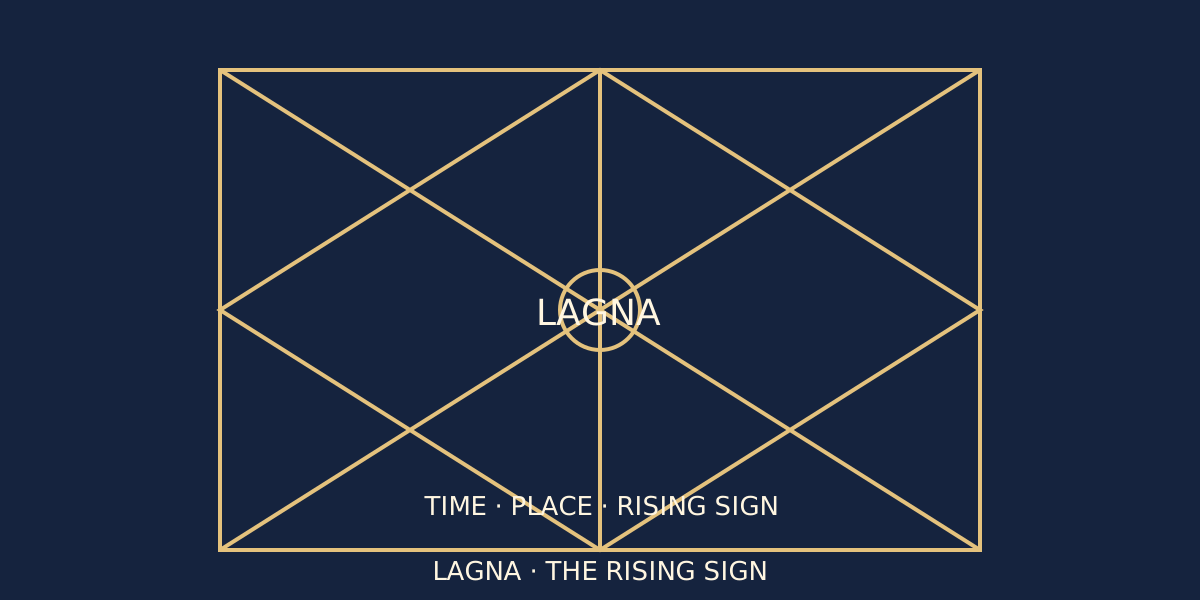
Lagna is the ascendant: the zodiac sign shown as rising on the eastern horizon for a particular birth time and place. In Jyotish, chart readers use it as a starting reference for houses and planetary placements. The term is also commonly translated as “rising sign.”
Lagna, Moon sign and Sun sign
Lagna describes the rising sign at the recorded birth moment and location. The Moon sign, often called Chandra Rashi, is the zodiac sign occupied by the Moon. The Sun sign is the sign occupied by the Sun. All three can appear in a Kundli, but they refer to different chart positions and are used differently in traditional readings. Interpretive methods vary, and none of these labels alone describes a whole person.
Why birth time and place matter
Lagna is tied to the local sky at a specific time. A calculation therefore needs a birth date, time and birthplace, as well as the relevant local time zone. The same clock time on the same date does not describe the same local horizon everywhere. If your time is approximate, say so. Uncertainty matters most near a sign boundary, so a careful guide should explain which chart details may change rather than present a guess as certain.
How to find Lagna in a Kundli
Look for a label such as “Lagna,” “Ascendant” or “As.” In many North Indian chart layouts, the first-house marker identifies the ascendant sign. In South Indian layouts, signs stay in fixed positions and a Lagna marker shows where the first house begins. Chart styles vary, so check the legend before interpreting the symbols. For a first study, note the Lagna sign, its ruling planet and that planet’s placement, then ask how the whole chart changes the interpretation.
Use the chart as a study prompt
A Lagna can help you understand how a chart is organised; it should not be treated as a fixed label for your personality or future. A fuller interpretation considers the question, calculation method and other chart factors. Continue with a beginner guide to the 12 houses in a Vedic Kundli and a comparison of Sun and Moon signs. If you do not know your birth time, see the guide to astrology without an exact birth time before relying on time-sensitive details. Astrology is a traditional interpretive practice, not a guarantee of life outcomes.
Frequently asked questions
Is Lagna the same as Rashi?
No. Lagna is the ascendant. In common Indian horoscope use, Rashi often refers to the Moon sign, though terminology can vary by tradition.
Can two people born on the same day have different Lagnas?
Yes. Birth time and birthplace are part of the calculation, so people born on the same calendar date may have different ascendants.
Can I know my Lagna without a birth time?
A precise Lagna generally needs a birth time. If it is unknown, do not treat a time-based chart result as certain; ask which broader details can still be discussed.