The short answer
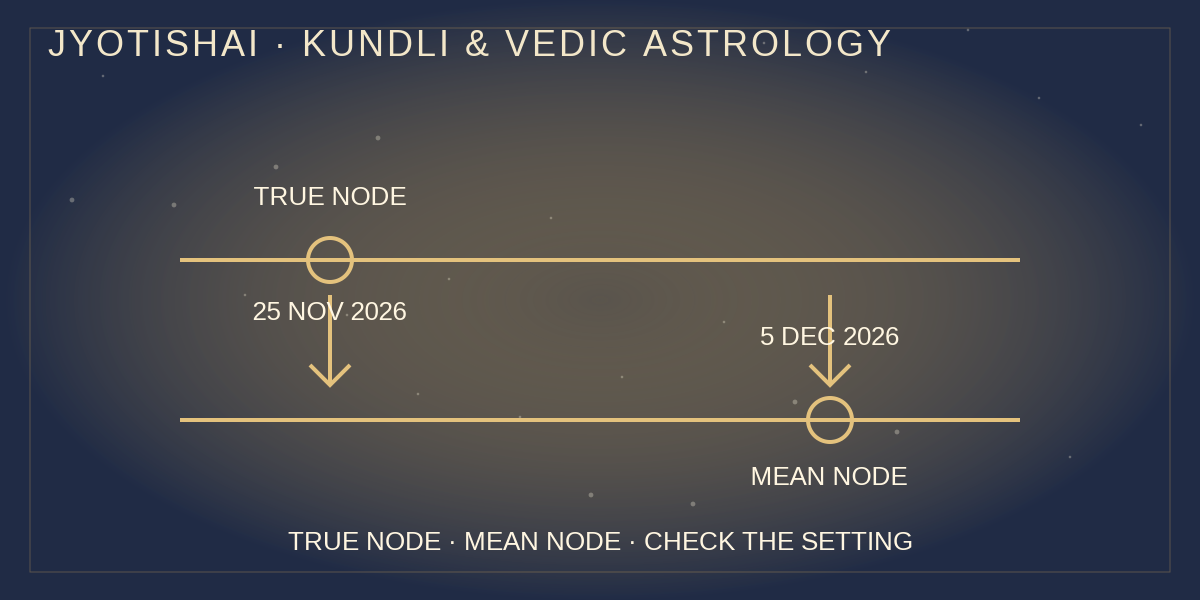
For the 2026 Rahu-Ketu sign change, some calendars show 25 November and others show 5 December. That ten-day gap is not automatically a typo: the lunar nodes can be calculated as the true node or the mean node, and the two points do not cross a sign boundary at the same time. The Government of India’s Rashtriya Panchang lists both conventions; Drik Panchang’s New Delhi transit page also displays both entries. Check the method named on your own chart or Panchang before comparing dates.
What are Rahu and Ketu in a chart?
In astronomy, the ascending and descending lunar nodes are the points where the Moon’s orbital path crosses the ecliptic. They are not physical planets. In Jyotisha, Rahu and Ketu are used as shadow grahas and are interpreted as opposite points on the zodiac. A software setting may calculate the node using the mean position or the true, instantaneous position; both names describe calculation conventions for the same nodal axis, not two separate Rahus.
The checked 2026 date example
The Rashtriya Panchang’s Saka 1948 (2026–27) transit table lists true Rahu entering Makara on 25 November 2026 and mean Rahu entering Makara on 5 December 2026. Its paired Ketu table places Ketu in Karkata on those respective entries. Drik Panchang’s New Delhi page lists true Rahu on 25 November at 4:34 pm and the other Rahu entry on 5 December at 7:28 pm, in New Delhi local time. Those clock times are tied to the source’s stated place and calculation; do not transplant them to another city or software setting.
Why transit pages can appear to disagree
A difference may come from the true-versus-mean node selection, a different ayanamsha, the chosen location and time zone, or whether a site reports the mathematical ingress moment or a Panchang observance date. Read the notes around a date table: identify the zodiac framework, node type, city and time standard. A page that leaves these unstated is difficult to compare, even if its headline date matches another site.
How to apply a transit date to a personal Kundli
A sign-change date is only a calendar input. In a traditional reading, an astrologer may consider the node’s house from the natal Lagna or Moon, its sign ruler, aspects, dasha context and the chosen calculation convention. Ask which settings were used and how they apply to your birth chart. A general 12-sign transit post cannot establish what will happen to one individual, and different Jyotisha schools may interpret the same placement differently.
A practical comparison checklist
When two transit calendars disagree, note the exact page and its location; check whether it says true or mean node; compare the ayanamsha or stated zodiac method; note local time and the definition of “ingress”; and keep the same settings when following later interpretations. If you consult a guide, ask it to explain the settings plainly. You do not need to combine predictions from incompatible charts to get a useful answer.
Use transit readings as tradition, not certainty
Rahu-Ketu interpretations belong to astrological traditions and are not verified predictions of a guaranteed event. A transit calendar can document a calculation within a selected system; it cannot guarantee a personal outcome. For consequential medical, legal, financial or safety decisions, use relevant professional guidance and practical information.
Frequently asked questions
Is Rahu in Capricorn on 25 November or 5 December 2026?
The Government of India Rashtriya Panchang lists the true node entry on 25 November and the mean node entry on 5 December. The right date for a reading depends on the method that reading uses.
What is the difference between mean Rahu and true Rahu?
Mean Rahu is a smoothed average position; true Rahu reflects the varying instantaneous orbital position. Their sign-boundary times can differ.
Which Rahu setting should I use for my Kundli?
Use the convention specified by the astrologer, Panchang or chart software you follow, and keep it consistent. Different traditions and tools may choose differently.
Does the date difference change every prediction?
A transit date alone does not predict an event. Interpretation depends on the chart, method and tradition, and is not a guarantee.
Continue learning
Sources and context
- India Meteorological Department, Rashtriya Panchang, transits into Nirayana signs: 2026–27 true and mean node entries
- Drik Panchang, 2026 Rahu Gochar for New Delhi: true and mean Rahu entries and local time notes
- NASA, Lunar Nodes and Eclipses: the orbital intersections that define node geometry
- AstroSage, 2027 Saturn transit coverage: current competitor example for annual transit intent
- Google Search Central, creating helpful and reliable people-first content
Citations provide cultural or practical context; they do not endorse JyotishAI or validate astrological predictions.